A network hop is one traversal from a graph node to an adjacent node along an edge. In graph neural networks, hops determine how far neighborhood information can influence a node embedding. section 2.4.4
Message passing connects hops to GNN implementation:
- Node features, edge features, or both form messages passed across the graph. section 2.4.4
- Each message-passing layer collects information from nodes or edges one hop away, then aggregates, transforms, and updates representations. section 2.4.4
- Three hidden message-passing layers give a node representation access to information up to three hops away, while neighborhood coverage can grow exponentially. section 2.4.4
Co-purchasing graph
For books connected by co-purchasing edges, a one-hop layer uses immediately connected books; three layers can incorporate information from books three hops away, including node or edge attributes. section 2.4.4
Figure 2.15 Elements of our message-passing layer. Each message-passing layer consists of an aggregation, a transformation, and an update step.
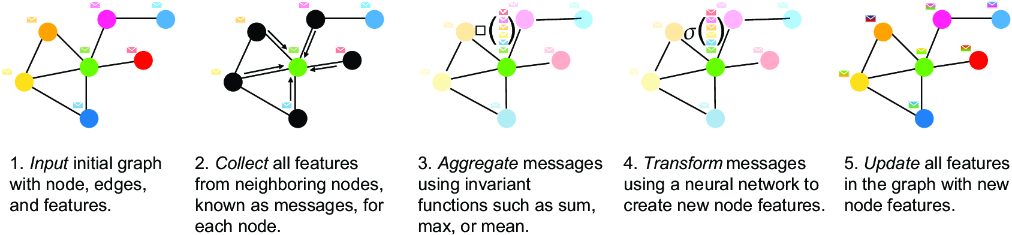
Use the message-passing layer diagram to trace aggregation, transformation, and update across one hop. section 2.4.4

