Node prediction estimates a label, attribute, or value for each graph node, using relationships and node information that ordinary tabular models may miss. It fits problems with implicit relationships, sparsity, high dimensionality, or complex nonlocal interactions. section 1.6 section 1.2.5
A practical graph-neural-network workflow typically follows this progression:
- Represent entities as nodes and meaningful relationships as edges, potentially starting from an adjacency matrix. section 1.2.5
- Train a baseline for the node-level target, then improve it with neighborhood aggregation. section 3.0
- Use message passing to exchange and aggregate neighborhood information before producing node predictions. section 1.6 section 3.0
Passenger outcomes from relationships
For Titanic data, represent passengers as nodes and family, cabin, travel, or social relationships as edges. The resulting graph supplies relational context for predicting passenger attributes or outcomes that a table alone may obscure. section 1.2.5
Figure 1.9 The Titanic dataset, showing the family relationships of the people on the Titanic visualized as a graph (Source: Matt Hagy). Here, we can see that there was a rich social network as well as many passengers with unknown family ties.
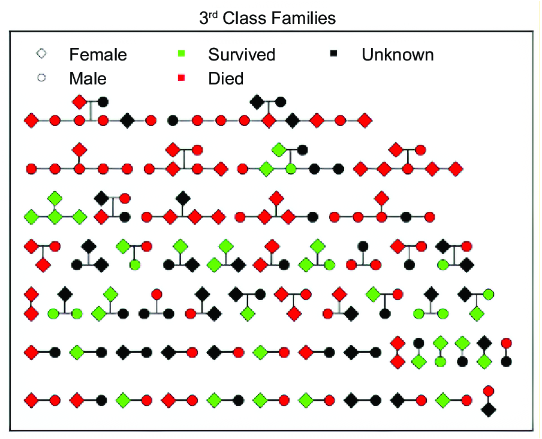
Inspecting the Titanic family-relationship graph makes the shift from isolated rows to connected predictive entities concrete. section 1.2.5
Node prediction is not automatically preferable to standalone models: when relational information is insignificant, a GNN may add unnecessary complexity. Model choice should reflect the graph structure and its trade-offs. section 1.6
