NTP organizes reference clocks and servers by stratum, their distance from an authoritative time source. Lower stratum values are preferred; physical distance is irrelevant. section 2.2
The hierarchy works as follows:
- Reference clocks such as atomic or GPS clocks are stratum 0; servers synchronized directly to them are stratum 1 primary servers. section 2.2
- Servers synchronized to other NTP servers are secondary servers and act simultaneously as NTP clients and NTP servers. section 2.2
- Stratum 15 is the highest usable level; stratum 16 is unreliable, so devices do not synchronize to it. section 2.2
- A device can use multiple NTP servers for redundancy, with the preferred server favored during selection. section 2.3.1
Figure 2.2 The NTP hierarchy. Reference clocks (stratum 0) are high-precision timekeeping devices such as atomic clocks. Stratum 1 NTP servers connect directly and sync to reference clocks. Stratum 2 NTP servers sync to stratum 1 NTP servers. Servers can peer with devices at the same stratum.
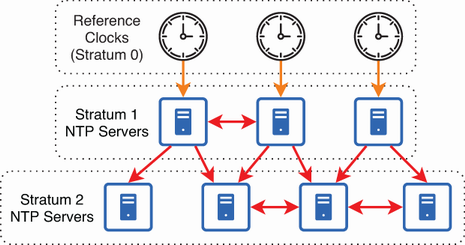
Trace synchronization from stratum 0 reference clocks through stratum 1 and stratum 2 servers, including same-stratum peering. section 2.2
