One-hot encoding converts a categorical field into binary indicator columns: one column per possible category, marked 1 when that category applies and 0 otherwise. It replaces arbitrary numeric labels with inputs suitable for analysis, including regression. For a patient slope coded 0, 1, or 2, create three mutually exclusive columns rather than treating the codes as meaningful numeric values. section 6.1.1
Figure 6.4 The original slope column and three new columns created by applying one-hot encoding
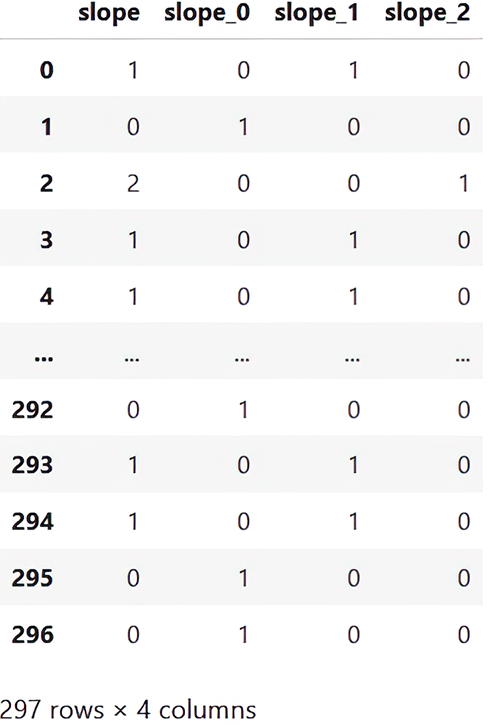
Compare the original slope values with the three binary columns created for the possible categories. section 6.1.1
The same idea handles multiple-choice responses stored as semicolon-delimited strings. Here, indicators need not be mutually exclusive: a respondent may select several options. First inspect the stored format and delimiter, then split answers into columns and verify that labels are clean enough for later grouping and comparison. section 6.4.2
Survey options with pandas
For respondents who use AI tools, turn a semicolon-delimited response column into one indicator column per use case with pandas `str.get_dummies(sep=";")`. Match the separator to the actual data, then strip whitespace from the generated column names. Column means give the proportion of users selecting each option; the indicators can then be joined back to survey data for crosstabs and heatmaps. section 6.4.2
Use one-hot encoding when an analysis needs categories as separate binary features:
- Convert nominal category codes into regression-valid inputs without implying that the codes have numeric order. section 6.1.1
- Separate multi-select survey answers so each selected option can be counted, visualized, and compared with sentiment, trust, or job category. section 6.4.2
- Prepare categorical data for broader analysis while pairing the transformation with appropriate missing-data, ordering, reshaping, and statistical-test decisions. section 7.3.1
“Dummy variables” is closely related terminology: technically, it means a one-hot representation with one column dropped. The practical judgment is to choose a representation that fits the data’s meaning—especially whether categories are exclusive—and the analytical task that follows. section 6.1.1 section 7.3.1
Categorical values arise in dropdowns, multiple-choice operational systems, surveys, and hierarchies such as countries, regions, and departments. One-hot encoding is one option within a wider categorical-data workflow rather than a substitute for understanding the data and selecting suitable analysis methods. section 6.5 section 7.3





