One-sided test
A one-sided test is a hypothesis test whose alternative hypothesis and rejection region concern a departure from the null in one prespecified direction.
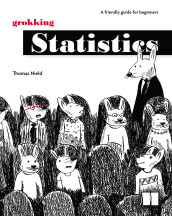
Grokking Statistics
A one-tailed hypothesis test that treats an unusually large deviation in one specified direction from the null value as evidence against the null hypothesis.
- How it is used
- Tests directional claims such as whether a mean is less than, greater than, or non-degrading relative to a benchmark.
- How deep it goes
- Works through hypotheses, tail selection, critical values, p-values, Python calculations, and normal-versus-t choices without formal derivations.
- Examples
- Uses underfilled potato-chip bags, above-average college exam scores, and comparative classroom math scores.
- What you can do after
- Apply it via SciPy to select a tail, calculate a critical value or p-value, and reject or fail to reject a directional claim.

Timeless Algorithms, The Foundational Ideas
A one-tailed test is a hypothesis test whose rejection region lies in one direction of the test-statistic distribution.
- How it is used
- Tests a directional claim, such as whether a drug raises recovery above a baseline, by placing rejection in one direction.
- How deep it goes
- Moves from directional hypotheses and significance level to an exact binomial test, naming independent outcomes and a shared null recovery probability.
- Examples
- Uses a drug trial for improvement and beverage fill-volume control to contrast directional with two-sided questions.
- What you can do after
- Evaluate/understand when a directional question calls for a one-tailed test rather than a test allowing deviations in either direction.
Read how Timeless Algorithms, The Foundational Ideas explains one-sided test →
What to know first
- sample sizeSample size is the number of observations, units, or items included in a sample or group being analyzed.
- student's t-distributionStudent’s t-distribution is a family of continuous probability distributions with heavier tails than the normal distribution, used in inference when variability is estimated from data.
Related concepts
- two-tailed testcontrasts with · A two-sided test is a hypothesis test in which sufficiently extreme results in either direction from the null value count as evidence against the null hypothesis.
- hypothesis testingpart of · Hypothesis testing is a formal statistical procedure for evaluating evidence from observed data about a specified hypothesis, often a null hypothesis.
- alternative hypothesisconfigured by · An alternative hypothesis is a statistical proposition that contrasts with the null hypothesis by asserting an effect, difference, relationship, or other departure.
- level of significanceuses · The level of significance is the prespecified maximum probability of rejecting a true null hypothesis in a statistical test.
- p-valueuses · A p-value is the probability, assuming a specified null hypothesis, of obtaining a test statistic or result at least as extreme as the observed one.
Questions about one-sided test
What is one-sided test?
A one-sided test is a hypothesis test whose alternative hypothesis and rejection region concern a departure from the null in one prespecified direction.
Which Manning books explain one-sided test?
Grokking Statistics and Timeless Algorithms, The Foundational Ideas.
What should I know before learning one-sided test?
Manning books that teach one-sided test usually introduce sample size and student's t-distribution first.
What is the difference between one-sided test and two-tailed test?
A one-sided test is a hypothesis test whose alternative hypothesis and rejection region concern a departure from the null in one prespecified direction. A two-sided test is a hypothesis test in which sufficiently extreme results in either direction from the null value count as evidence against the null hypothesis.
What is one-sided test part of?
One-sided test is part of hypothesis testing. Hypothesis testing is a formal statistical procedure for evaluating evidence from observed data about a specified hypothesis, often a null hypothesis.
These guides are generated from the text of Manning books by Manning's knowledge graph and link to the sections they draw on. The full books are available on liveBook and at manning.com.