A one-sided, or one-tailed, test asks whether a population value moves in one specified direction from a benchmark. Use a left-tailed test for a “less than” claim and a right-tailed test for a “greater than” claim. Unlike a two-sided test, it does not treat movement in the opposite direction as evidence against the null hypothesis. section 6.8 section 6.15
The hypotheses must be opposite directional statements. To investigate whether chip bags are underfilled relative to 142 grams, write H₀: μ ≥ 142 and Hₐ: μ < 142. All of the significance level α sits in the left tail; for a claim that a mean is greater, place α in the right tail instead. section 6.8 section 6.9
A one-sided test follows this practical sequence:
- State the direction that matters: less than for the left tail or greater than for the right tail. section 6.9
- Calculate a test statistic from the sample, then locate its critical boundary or calculate its p-value. section 6.10 section 6.11
- Reject H₀ when the statistic enters the chosen critical region, or when p-value < α; otherwise fail to reject H₀. section 6.15
- Choose the distribution for the sample situation: the normal distribution is used here for n > 30, while smaller mean samples use the t-distribution with n − 1 degrees of freedom. section 6.12 section 6.15
Are 142-gram chip bags underfilled?
A sample of 41 bags has mean 140.2 grams and standard deviation 4.79. For Hₐ: μ < 142 at α = .05, the Z statistic is −2.40618 and the left-tail critical Z is −1.64485. Because the statistic lies beyond that boundary, reject H₀: the sample supplies sufficient evidence that the mean bag weight is less than 142 grams. section 6.10
Figure 6.9 Zooming in on the left tail, the p-value for our left-tailed test is compared with α = .05. Because the area of p is less than α, we reject the null hypothesis.
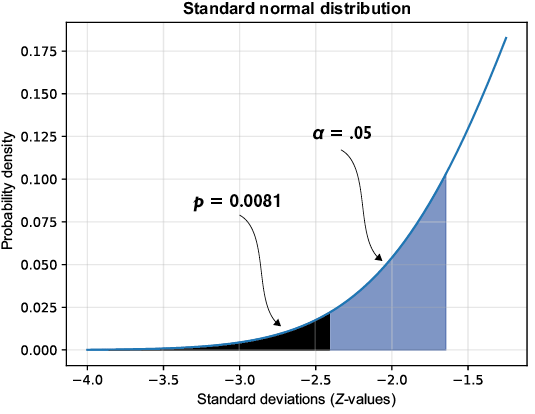
The shaded left tail compares the p-value with α. A p-value smaller than α falls within the rejection rule for the directional claim. section 6.11
One-sided tests make rejection easier at the same α because they concentrate the full significance area in one tail rather than split it across two. That gain comes with a limit: a result in the untested direction is ignored. Use this approach only when the question genuinely cares about one direction; two-sided tests are generally preferable when direction is uncertain, especially for mission-critical decisions. section 6.10 section 6.11 section 6.8
