An open-source model gives a business more control over deployment, customization, infrastructure, and data handling than a commercial LLM API. That control can protect sensitive information, but it shifts responsibility toward model selection, infrastructure, and MLOps. section 5.3.2 section 11.2.1
Choose an open-source deployment by balancing:
- Privacy and governance: internal hosting can keep customer inputs and proprietary data off third-party servers, which matters in regulated industries such as healthcare and finance. section 5.3.2 section 11.2.1
- Capability, latency, and cost: smaller models can respond faster and cost less, while larger models may provide stronger quality or broader capability. section 5.3.2
- Operating capacity: internal hosting requires skills in AI, infrastructure management, model customization, and robust MLOps. section 5.3.2
- Adoption timing: experiment with managed APIs to test feasibility, then consider fine-tuning and hosting after product-market fit. section 5.4.1
Selecting a model for a regulated product
A team serving healthcare or finance customers may host an open-source model internally to avoid sending user data to commercial providers. It can compare Llama, Mistral, and Qwen variants, then test whether a smaller model meets quality and latency requirements before accepting the cost of a larger model. section 5.3.2 section 11.2.1
Figure 11.5 Major privacy concerns in an AI system
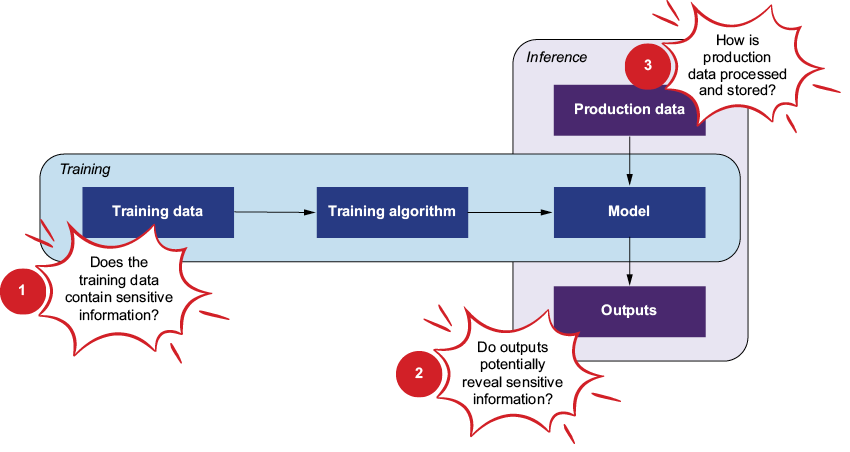
Use the privacy-risk overview to examine training-data composition, retention, and unintended exposure when comparing internal and commercial deployment. section 11.2.1




