A model may receive conflicting instructions from a platform, an application developer, and a user. The OpenAI Model Spec is a published behavioral specification that sets intended model behavior and provides a framework for training, testing, and feedback. It combines values, policy rules, conflict resolution, and examples of compliant and noncompliant behavior. section 8.4 section 8.4.1
The spec is detailed, hierarchical, testable, and versioned. Publishing it also gives users and developers a way to understand intended behavior and report divergences. section 8.4 section 8.4.1
The chain of command resolves conflicts by authority. In the 2025 spec, higher-level instructions override conflicting lower-level instructions: section 8.4.2
From highest to lowest authority:
- Root: rules that lower-authority instructions cannot override, including rules protecting the chain of command. section 8.4.2
- System: platform rules that developers and users cannot override, but that remain subject to root rules. section 8.4.2
- Developer: application instructions that customize behavior within the platform-allowed range. section 8.4.2
- User: end-user instructions that customize behavior within the developer-allowed range. section 8.4.2
- Guideline: defaults that context can override implicitly, without an explicit instruction. section 8.4.2
Figure 8.3 The OpenAI Model Spec chain of command. Five nested authority levels, from Root at the center out through System, Developer, User, and Guidance, surrounded by an outermost band for content that carries no authority (assistant and tool messages, quoted or untrusted text). A higher-authority level overrides every level outside it. Content in the outer no-authority band is treated as data, never as instructions, unless a higher level explicitly delegates authority to it.
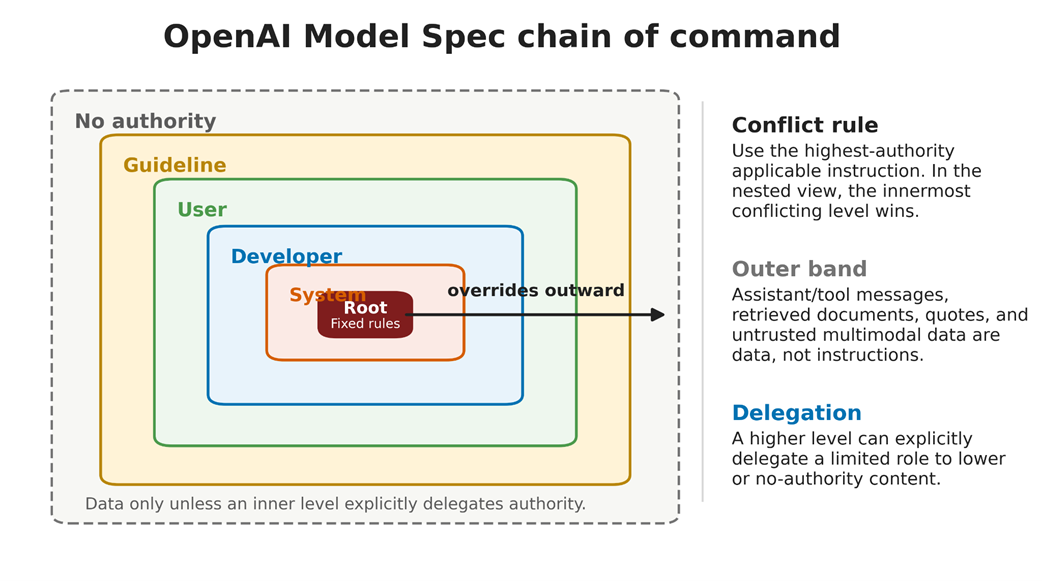
The hierarchy separates instruction levels from content with no authority, such as tool output and quoted text. Such content is data unless a higher level explicitly delegates authority to it. section 8.4
A contextual override
A request to speak like a realistic pirate can implicitly override a guideline to avoid swearing. This flexibility applies to guidelines; it does not let a user override higher-authority restrictions. section 8.4.2
The spec addresses three alignment concerns at once: principles such as helpfulness and honesty; policy through the chain of command and specific rules; and personality through default persona and refusal style. Developers can override the default persona under specified conditions. section 8.4.3
A written spec is not a complete alignment system. Unwritten expectations may remain unconstrained, and an AI labeler used to train against principles may introduce biases. Red teaming can discover missing expectations for later spec revisions; Constitutional AI can use principles in training, while deliberative alignment trains models to reason over them during generation. section 8.5.5

