Operations research applies a mix of analytical techniques to practical decisions under constraints. One application selects a free-agent roster that maximizes projected win shares while satisfying strict roster, salary, and age requirements. section 20.5
Constrained optimization makes the decision explicit:
- Maximize a linear, continuous objective such as projected win shares. section 20.5
- Enforce hard constraints: acquire exactly five players, fill each unique position, keep salaries at or below $90 million, and keep average age at or below 30. section 20.5
- Use lpSolve to return an optimal selection from a short list of 24 available players. section 20.5
A feasible optimal roster
The model selects one player at each position, with total annual salaries of $89.5 million and an average signing age of 28.4. Any alternative is less optimal or violates a hard constraint. section 20.5
Figure 20.5 The operations research learning area contains a hodgepodge of techniques. In chapter 4, we demonstrated how an NBA team in the free agent market could get the biggest bang for its buck by setting up a constrained optimization problem; in chapter 8, we tested how well the optimal stopping rule, otherwise known as the 37% rule, works with a 24-second shot clock; in chapter 9, we examined permutations versus combinations (before computing permutations of prior days off between home and road teams); and in chapter 15, we demonstrated the 80-20 rule, often called the Pareto principle, and visualized how it applies to games played and won by all-time NBA franchises.
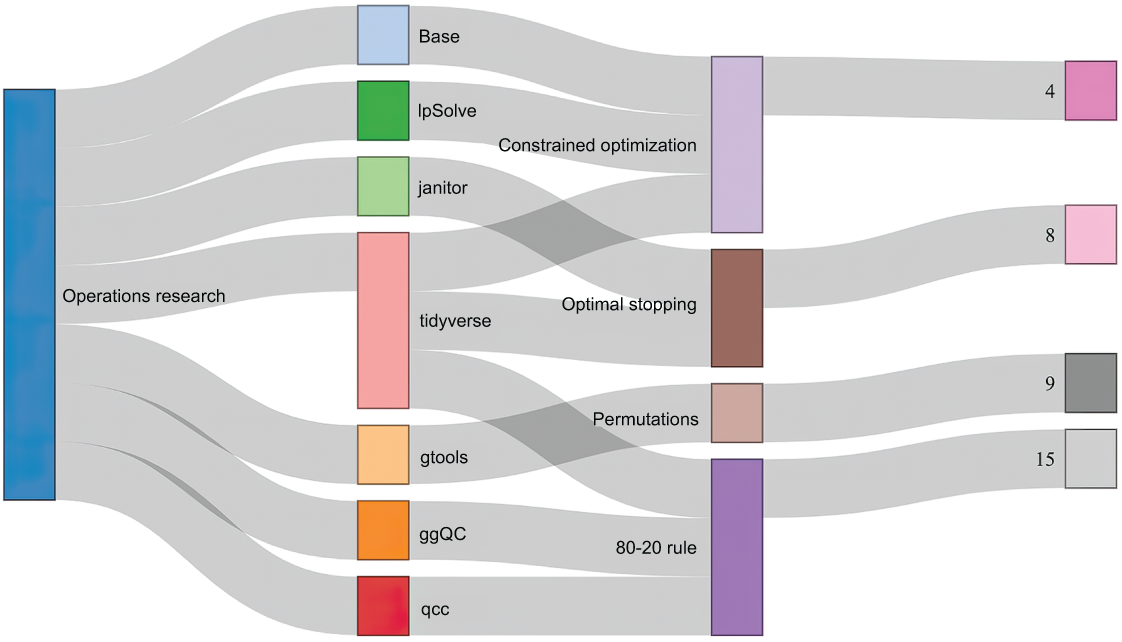
Survey the connected techniques: constrained optimization, optimal stopping, permutations and combinations, and the Pareto principle. section 20.5

