Orthogonality describes vectors or directions that meet at a right angle. In an orthogonal pair, the dot product—the sum of coordinate-wise products—is zero. This gives geometry a practical test for perpendicularity rather than relying only on visual inspection. section 5.3.2 section 2.1.2
Orthogonality appears in several useful geometric roles:
- Smoothly joining an arc to a line segment requires the vector from the arc center to the intersection point to be orthogonal to the segment. section 5.3.2
- An orthonormal basis combines orthogonal directions with unit length; other bases may be nonorthogonal or non-normalized. section 2.1.2
- The cross product produces a vector orthogonal to both input vectors, making it a normal vector for their shared plane. section 9.3.4
Constraining an arc and line segment
Represent the line segment with tangent vector (dx2, dy2) and the vector from the arc center (ax1, ay1) to the intersection (ix, iy). Enforce orthogonality with (ix − ax1)dx2 + (iy − ay1)dy2 = 0. Combined with the point and center equations, this lets SymPy solve for the unknown center, intersection, and parameter. section 5.3.2
Figure 5.21 An arc can be joined smoothly with a line segment so that we have both straight and curvy pieces in one building block.
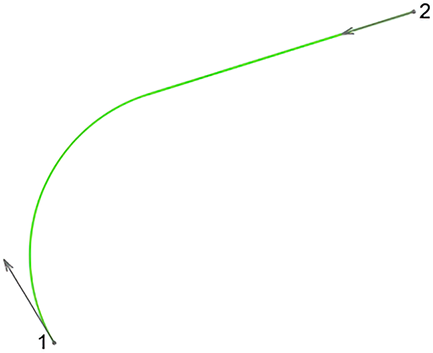
Use the arc-and-segment figure to connect perpendicularity with the practical goal of creating a smooth geometric join. section 5.3.2



