Orthogonal quantum states have inner product zero and can be distinguished perfectly with a suitable measurement. This makes orthogonality central to quantum state discrimination: given a register promised to contain one state from a known orthogonal list, measurement can identify which state was supplied. section 4.2 section 4.9
Use orthogonality to reason about distinguishability:
- States may share computational-basis components and still be orthogonal; the signs or complex amplitudes can make their inner product vanish. section 4.3
- When computational-basis measurement does not uniquely identify the state, transform the desired measurement basis into the computational basis, measure, and interpret the mapped outcome. section 4.3.1
- Unitary transformations preserve orthogonality, enabling this change of measurement basis. section 4.3.1
Hadamard-basis discrimination
The states |+⟩ = (|0⟩ + |1⟩)/√2 and |−⟩ = (|0⟩ − |1⟩)/√2 are orthogonal despite sharing both basis states. Applying a Hadamard gate maps them to |0⟩ and |1⟩, after which computational-basis measurement identifies the input perfectly. section 4.3 section 4.3.1
Figure 4.4 To do a measurement in Hadamard basis, we need to find a unitary transformation that maps the states of the Hadamard basis, \(\ket{+}\) and \(\ket{-}\), into the computational basis states \(\ket{0}\) and \(\ket{1}\). This is exactly the effect of the Hadamard gate! After this, a measurement in the computational basis will let us figure out which of the states we started with, \(\ket{+}\) or \(\ket{-}\).
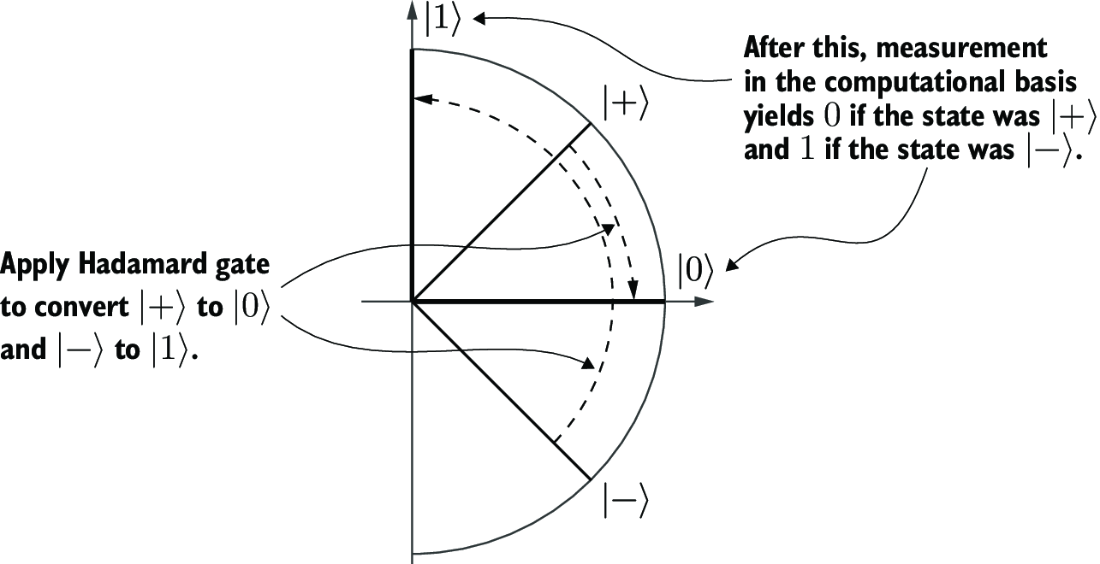
Use the figure to trace the Hadamard-basis measurement: map |+⟩ and |−⟩ to computational-basis states, then measure. section 4.3.1



