Orthogonalization reduces the impact of nuisance-model errors on a causal parameter by enhancing existing estimators with machine learning. It expresses the causal effect as the solution to an equation defined by a score function, analogous to a loss function. DML is one important case of this broader technique. section 8.1.3 section 8.1.3
The practical picture has three parts:
- A target causal parameter is estimated through a score function specific to the causal model and parameter. section 8.1.3
- Nuisance functions, such as propensity scores, support estimation but are not themselves the primary causal target. section 8.1.3
- DML combines orthogonalization with cross-validation and cross-fitting to address confounding, overfitting, and same-data prediction bias. section 8.1.3
Two-fold cross-fitting applied to the DML algorithm. Once the process is finished, you must switch roles between datasets 1 and 2. This process can be generalized to k-fold cross-fitting by breaking the data into k datasets instead of two.
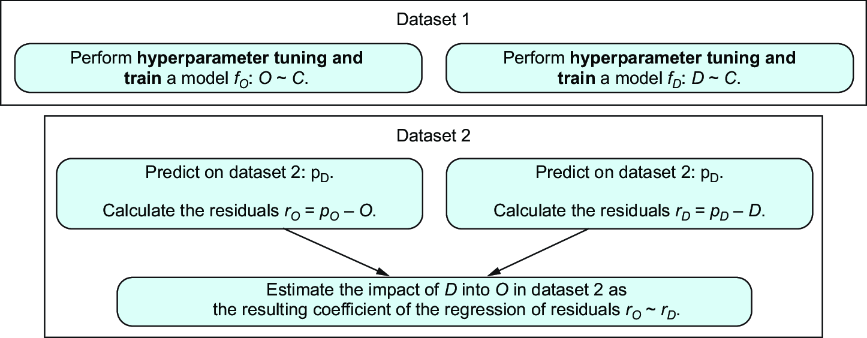
Two-fold cross-fitting illustrates how datasets switch roles during DML, with the process generalizing to k-fold cross-fitting. section 8.1.3
