liveBook · Manning

Anomaly score

As explained in Azure Security

Anomaly scoring is a web application firewall evaluation method that assigns a cumulative score to detected request anomalies to determine whether traffic is blocked.

Anomaly scoring lets Azure WAF on Application Gateway evaluate suspicious requests cumulatively before deciding whether prevention mode should block them. section 3.3.1

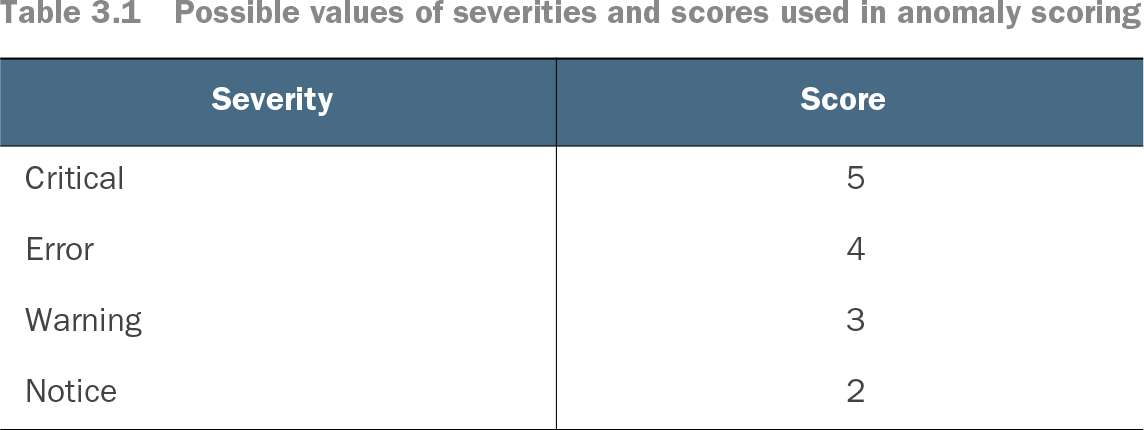
Azure WAF assigns scores by rule severity:

  • Critical: 5; Error: 4; Warning: 3; Notice: 2. section 3.3.1
  • The score is cumulative across matching rules. section 3.3.1
  • Prevention mode blocks requests with a total score of 5 or higher. section 3.3.1

Combined rule matches

A request matching one rule scored 3 and another scored 2 reaches a cumulative anomaly score of 5, so prevention mode blocks it. section 3.3.1

Table 3.1 Possible values of severities and scores used in anomaly scoring (view table figure)

Severity

Score

Critical

5

Error

4

Warning

3

Notice

2

Use the severity-and-score table to compare the values that contribute to an anomaly score. section 3.3.1


How Azure Security covers it

How deep it goes
Explains severity values, cumulative addition, and the prevention threshold, but does not detail individual rule logic.
Examples
Uses critical, error, warning, and notice scores plus a two-rule total of 3 and 2.
What it assumes
Assumes familiarity with WAF policies, managed rule sets, and prevention mode.
What you can do after
Operate/configure prevention behavior by interpreting rule severities and predicting when requests will be blocked.
How it connects
Connects anomaly scoring with Azure WAF, Application Gateway, managed rule sets, and prevention mode.

Also explained in

Compare how 2 books explain anomaly score →

Related concepts

This explainer was generated by Manning's knowledge graph from the text of Azure Security. The section links point to the parts of the book it draws on.