Pair programming puts two programmers on the same problem and makes responsibility shared rather than solitary. Used deliberately, it can reduce social debt: isolated “lone wolf” work, knowledge hoarding, cookbook habits, and newcomers coasting without learning. Switching pairs regularly matters; the benefit belongs to the team, not to a fixed duo. section 3.4.4
Two watchful perspectives can improve code quality, spread learning, and support confidence and happiness. Those gains are plausible reasons to pair, not a command to pair constantly. A good session invites discussion and new input, while insight often needs quiet time afterward to settle. section 3.4.4 section 7.4.1
Treat pairing as a flexible habit:
- Rotate partners so knowledge and responsibility circulate rather than becoming trapped in one pairing. section 3.4.4
- Match pace thoughtfully. An expert may be far ahead of a novice, making unspoken details hard to transfer. section 7.4.1
- Leave breathing room after collaboration. Discussion helps collect ideas; individual reflection helps connect them into insight. section 7.4.1
- Use side-by-side work to understand another person’s assumptions before trying to correct a mistaken judgment. section 5.4.8
All day, or sometimes?
Imagine a team that pairs every hour of every day. It may learn rapidly and feel close-knit, yet its members can become exhausted or unable to think at their own pace. Pairing only occasionally restores processing time, but may slow the spread of practices and camaraderie. The useful question is not “pair or solo?” but “what rhythm helps this team learn and think?” section 7.4.1
Figure 7.5 The evolution of seemingly loose data to insight and wisdom. Based on ideas of the Gapingvoid Culture Design Group.
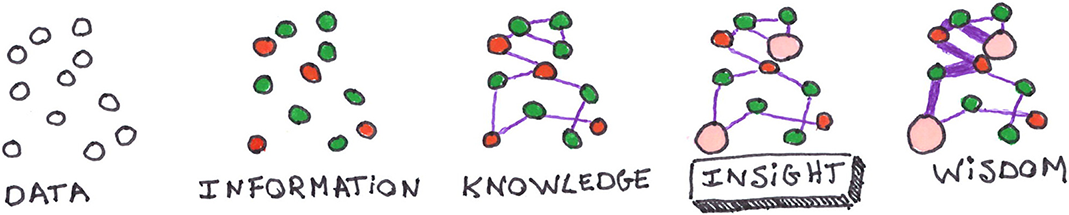
The figure supports the distinction between gathering loose input together and personally turning it into insight: collaboration can supply dots, while reflection connects them. section 7.4.1




