A patch groups consecutive time-series observations into one token or model input unit. Grouping local points helps models learn nearby relationships while reducing the number of tokens sent to the embedding layer. section 6.1.1
Patching supports several implementation choices:
- A patch length of two groups two observations before tokenization, rather than sending each observation separately. section 6.1.1
- Moirai selects patch lengths according to data frequency, while Moirai-MoE uses one fixed length and nonoverlapping patches across series. section 6.2.1 section 6.1.1
- Time-LLM normalizes and patches the series before embedding patches and translating them through learned text prototypes. section 9.1.1
Patch reprogramming example
A patch can receive descriptions such as “down steady” or “up short”; combining prototypes can describe a patch as “down steady then up short.” section 9.1.1
Figure 6.2 The process of patching. Typically, each data point (circle) is a token that’s sent to the embedding layer. With patching, we group data points, and each patch becomes a token that is sent to the embedding layer.
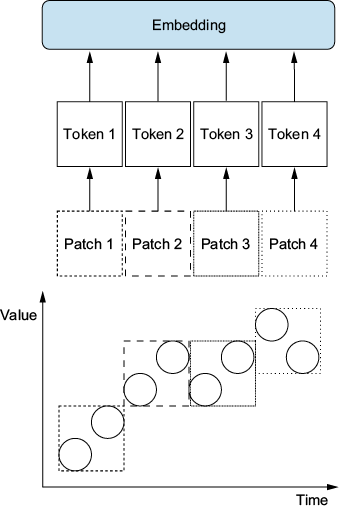
Shows how multiple time-series points become one token before entering the embedding layer. section 6.1.1




