A path is an ordered chain of connected elements linking a start to an end. In a word ladder, each step applies a permitted transformation, such as changing, adding, removing, or reordering letters. section 5.1
Representing words as nodes in a graph turns the ladder into a search problem: edges connect words reachable in one step, and a path records a possible chain between two nodes. section 5.1.1
A path can support several practical decisions:
- Compare alternative paths and select the shortest one, such as cat → cats → tags → goat → got → dog. section 5.1.1
- Model connections as directed or undirected, depending on whether movement is allowed in both directions. section 5.1.1
- Treat every edge as one equal-cost step when the problem does not require weighted paths. section 5.1.1
- Generalize the same abstraction to navigation systems, databases, network routers, and Sudoku solvers. section 5.1
Word-ladder paths
A simple path is cat → sat → sag → dag → dog. With broader transformations, find can reach solution through find → fins → ions → loins → tonsil → lotions → solution. section 5.1
Figure 5.1 A solution for find and solution in the modified ladder game
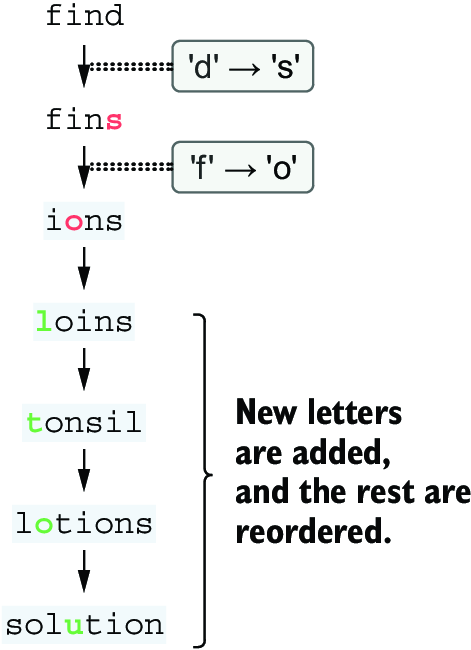
Use the worked ladder diagram to trace how each permitted word transformation contributes one step toward the destination. section 5.1