Pconsc4 predicts which residue pairs in a protein are physically close. It builds 72 features from a multiple sequence alignment (MSA), then uses a U-Net encoder-decoder with skip connections to produce a contact-probability matrix. section 11.3.1
The prediction pipeline connects evolutionary signals to a protein graph:
- Search sequence databases for homologous proteins and align their sequences into an MSA. section 11.3.1
- Calculate position-specific amino acid frequencies, mutual information, direct coupling statistics, and other features for residue positions. section 11.3.1
- Predict contact probabilities, threshold them at 0.5, and use the resulting contact map as a graph adjacency matrix. section 11.3.1
Figure 11.5 Transforming a Protein's 3D Structure into a 2D Graph. Converting a protein's spatial information into a graph representation. (a) A simplified 3D protein structure with dashed lines connecting amino acid residues that are in close spatial proximity (a 'contact'). (b) Spatial information is translated into a contact map, which is a 2D matrix. A point at (i, j) is marked if residue i and residue j are in contact, serving as an adjacency matrix for the graph. (c) The contact map is used to construct a graph where the amino acid residues are the nodes and the contacts are the edges. This graph captures the key residue interactions in a format that is invariant to the protein's rotation and translation in 3D space.
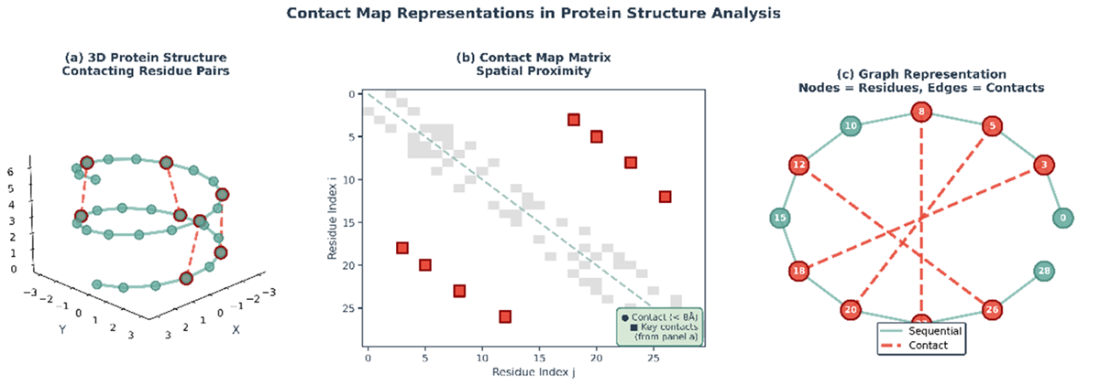
Trace how predicted residue contacts become a two-dimensional contact map and then a protein graph with residues as nodes and contacts as edges. section 11.3.1
