A graph can be represented with its nodes in different orders without changing the relationships between them. Permutation invariance means a graph-learning method is unaffected by that ordering: shuffling the rows and corresponding columns of an adjacency matrix should not change its performance. This makes it a useful design principle for relational data. section 1.2.4
In a graph neural network, information moves across connections between nodes. When a node gathers information from its neighbors, the aggregation operation must not depend on which neighbor appears first. Averaging, summing, or taking the maximum of neighborhood values are examples of operations that meet this requirement. section 1.5.2 section 3.4.1
Figure 3.12 A comparison of convolution over grid data (left; e.g., a 2D image) and over a graph (right).
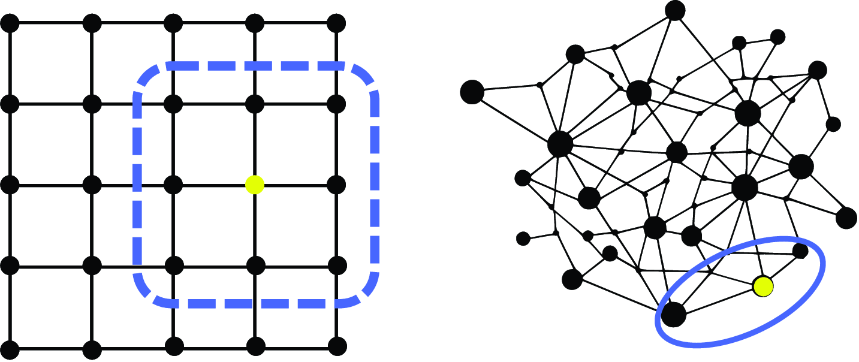
Compare the fixed grid neighborhood of an image with a graph neighborhood defined by edges. The graph operation must handle connected nodes without relying on their order. section 3.4.1
This is an inductive bias, not a rule for every dataset. Shuffling image rows or columns changes the image; image models instead commonly seek translational invariance. Choose permutation-invariant operations when order is incidental to the relationships being modeled, rather than when position carries meaning. section 1.2.4

