A persistent volume represents durable storage for a Kubernetes workload independently of a Pod’s lifecycle. During VM-to-container migration, it provides a destination for application data that cannot simply become part of the container image. Migrate for Anthos (M4A) refactors VM storage into a Kubernetes-supported persistent volume while leaving networking, logging, and other shared functions to Kubernetes. section 15.3.2 section 15.4.3
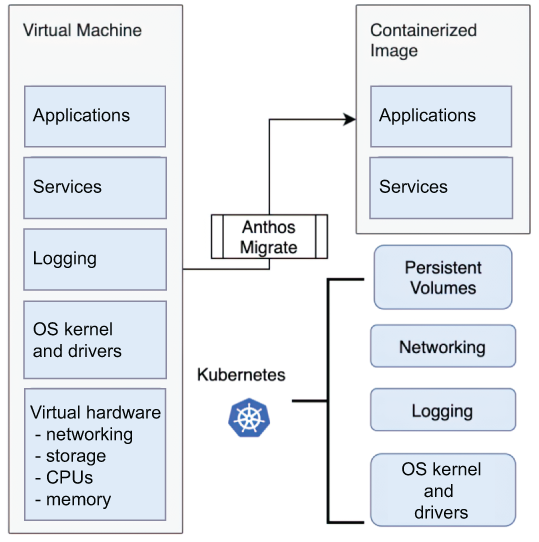
The VM-to-container diagram places persistent storage among the deployment artifacts rather than the VM components retained in the container image. section 15.3.2
The generated deployment YAML depends on the migration intent:
- ImageAndData describes a stateful application with a StatefulSet of Pods, a PersistentVolume for durable storage, and a PersistentVolumeClaim requesting storage characteristics such as size and access mode. section 15.4.3
- Data includes PersistentVolume and PersistentVolumeClaim resources without the image-deployment components listed for ImageAndData. section 15.4.3
M4A mounts a persistent volume through its Container Storage Interface (CSI) driver and streams data from the source VM filesystem. Review the generated storage configuration before deployment: M4A does not automatically migrate NFS mounts. For an NFS share, manually define the persistent-volume directives and add them to the generated Pod YAML. section 15.3.2 section 15.5






