A pilot project is a limited deployment of an agentic system used to test economic viability, governance resilience, and the case for broader adoption. Its purpose is not immediate profit, but validating the system’s Net Agentic Value trajectory before major architectural commitments. section 3.8
Evaluate a pilot against the conditions that determine whether autonomy can survive production scale:
- Allow for a learning period; early build and failure costs can make Net Agentic Value appear negative during the first six months. section 3.8
- Account for enterprise-wide governance, observability, and safety costs rather than comparing them only with local labor savings. section 3.8
- Test delegated decision authority, not merely task accuracy; systems that only suggest may miss the coordination and timing value of autonomy. section 3.8
- Make authority boundaries, escalation ownership, organizational readiness, and expansion criteria explicit before migration. section 4.5 section 4.5.1
Pilot-scale operation often relies on shared knowledge and informal human judgment. Production scale removes that substitute: teams expand, decision surfaces widen, and previously implicit boundaries require formal architecture and governance. section 4.5.1
Figure 4.7 Structural stresses that undermine pilot-to-production migration. Four stresses act simultaneously on the agentic pilot as it transitions to production. Each is absorbed by human judgment at the pilot scale and becomes architecturally significant at volume.
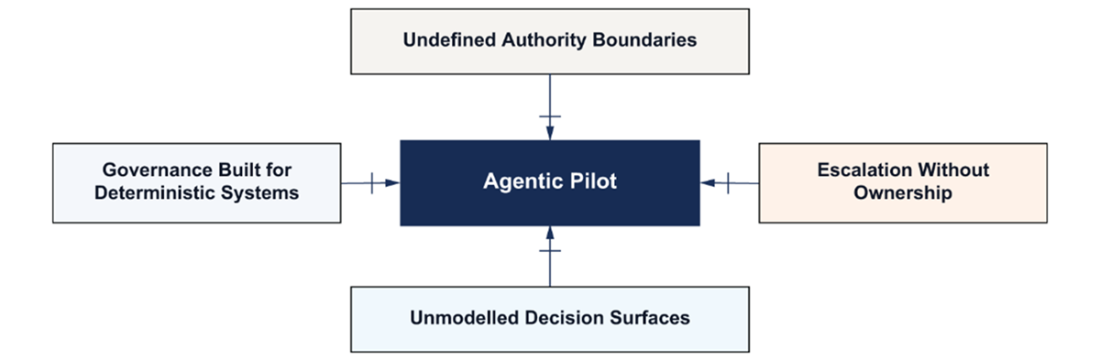
Use the figure to inspect the four structural stresses that converge during pilot-to-production migration; each is absorbed by human judgment at pilot scale and becomes architectural at volume. section 4.5.1

