A platform service is a centrally provided capability that multiple AI applications consume instead of rebuilding independently. It turns a prototype's direct model call into a production-ready system with shared infrastructure for reliability, security, observability, cost control, and operational scale. section 1.0 section 1.2.2
A platform service consolidates recurring application requirements such as:
- Session management for conversational state and reusable interaction infrastructure. section 1.6
- Observability for token usage, response quality, conversation patterns, monitoring, logging, and metrics. section 1.6
- Guardrails and infrastructure that establish consistent API-key handling, input sanitization, logging, and security defaults. section 1.6
- Experimentation and shared configurations that let improvements in prompts or safety settings benefit multiple applications. section 1.6
Service access through an SDK
A workflow creates one GenAIPlatform object, then accesses services through clients such as platform.sessions.get_or_create(), platform.models.chat(), and platform.data.search(). The SDK connects to a gateway, service-specific clients attach routing metadata, and the gateway forwards calls to the appropriate backend. Developers write local-looking function calls while deployment, networking, and distributed-service coordination remain behind the interface. section 2.5 section 2.5.4
Figure 2.6 The SDK provides three core capabilities: the GenAIPlatform object configures gateway connections through environment variables or explicit parameters; lazy-initialized service clients (SessionClient, ModelClient, DataClient) connect to the gateway with service-specific metadata; and the @workflow decorator captures deployment configuration that the deployment tool uses to package and register workflows with the Workflow Service. This architecture enables Sarah to write simple code that hides substantial infrastructure complexity.
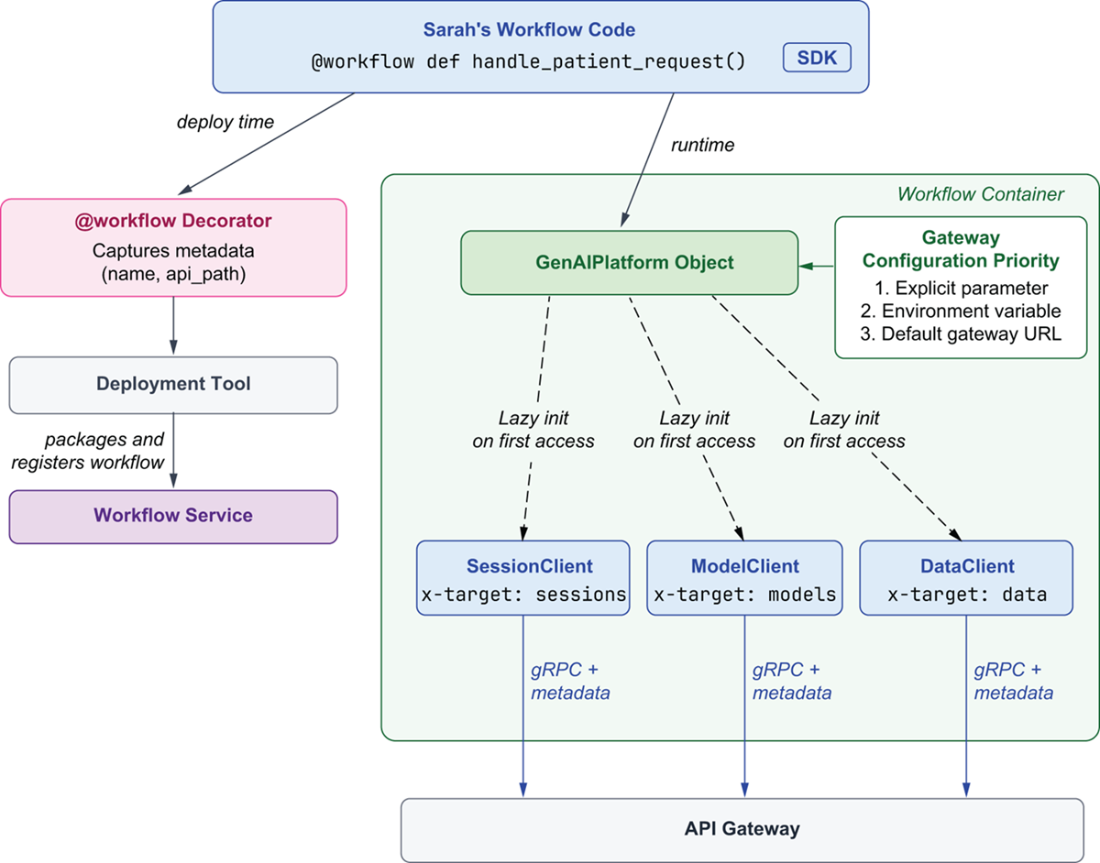
The architecture diagram shows how a platform object, lazy-initialized service clients, gateway connections, and workflow deployment configuration hide distributed infrastructure behind a consistent SDK. section 2.5

