Polarity management handles ongoing tensions whose alternatives are interdependent rather than mutually exclusive. Instead of forcing an either/or choice, a group maps both sides, recognizes their benefits and drawbacks, and agrees when to move between them. section 10.0 section 10.7
Use a polarity map to turn disagreement into shared observations and agreed responses:
- Name the two interdependent poles and create a shared understanding of the tension. section 10.2
- List the positive and negative effects of each pole, encouraging perspectives from both sides. section 10.3.3 section 10.7
- Identify signals or observations that show when the group is overusing one side. section 10.3.3
- Define actions or heuristics for moving toward the other pole, then use shared agreements to guide future transitions. section 10.2 section 10.7
Deep versus wide modeling
During a BigScreen modeling session, participants disagreed about whether to explore the model deeply or spread broadly. Rather than choosing one side, facilitators divided the group into mixed subgroups. Each subgroup listed the benefits and drawbacks of diving deep and spreading wide, compared maps, and considered the fear of leaving the polarity unmanaged. The group then examined signals arising during software architecture decisions and developed actions for shifting between modeling and coding. section 10.2 section 10.3.3
Figure 10.1 Empty polarity map
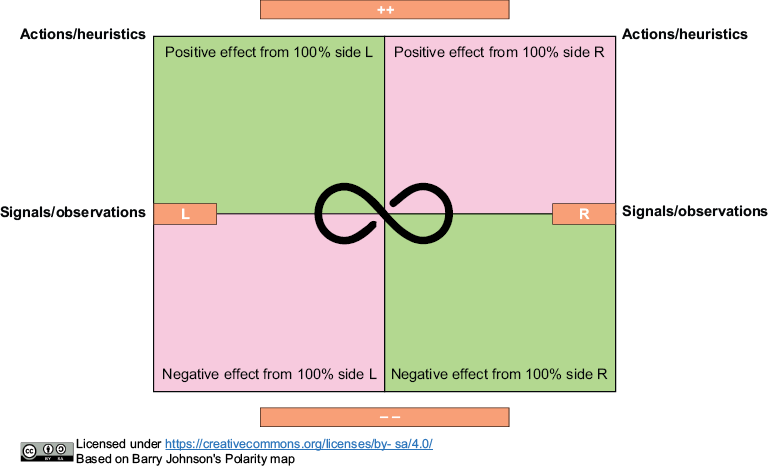
Use the empty polarity map as a canvas for recording both poles, their positive and negative effects, warning signals, and responsive actions. section 10.2
