A policy is the decision rule that maps the agent’s present state to its next action. In sequential environments, it guides choices toward maximizing total rewards under uncertainty. section 5.1.1
Policy operates across two related decision-making settings:
- Within an MDP, the policy connects states, actions, rewards, and the agent’s long-term objective. section 5.1.1
- Within preference alignment, an LLM policy is adjusted to favor responses labeled preferred over undesirable alternatives. section 5.2
- RLHF maximizes policy performance through a reward model, whereas DPO directly optimizes the policy without an explicit reward model. section 5.2
Dog-training obstacle course
The dog acts as the agent, obstacles represent states, jumping or crawling supplies actions, and treats provide rewards. A learned policy selects actions that increase expected treats over the course. section 5.1.1
Figure 5.1 A simplified comparison of RLHF and DPO and how DPO directly optimizes for the policy without an explicit reward function
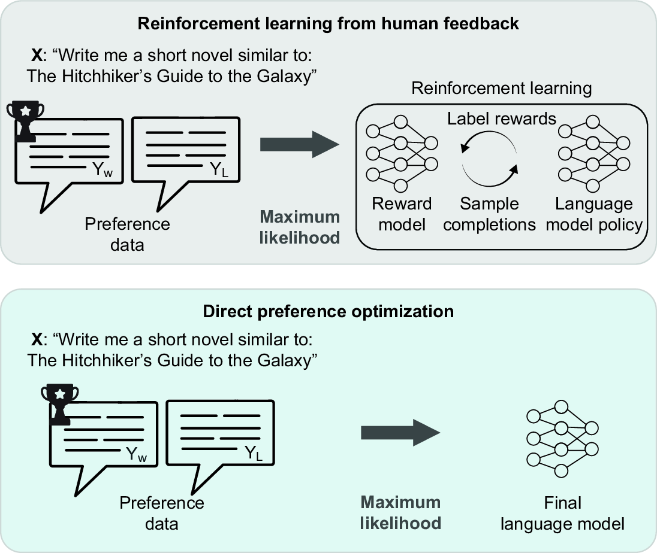
Compare RLHF’s reward-model pathway with DPO’s direct policy-optimization pathway. section 5.2












