Policy analysis systematically examines authorization rules to determine whether they express organizational intent and produce the expected security outcomes. It is especially valuable when small policy changes interact in ways that are difficult to predict. section 17.2 section 17.3
Effective analysis connects policy design with observed authorization behavior:
- Draft, clarify, and refine candidate policies while keeping the policy engine as the enforcement authority. section 17.2
- Ground questions in concrete requests, expected results, entities, actions, attributes, and the actual schema. section 17.2.3
- Compare intended rules with production decisions to expose mismatches, surprising outcomes, edge cases, and governance concerns. section 17.3
Concrete request analysis
Ask, “What would change if this request were made outside business hours?” or “Which policy denies access when the requester is not a workspace member?” Checking the answer against the actual model makes unsupported entities, actions, or attributes visible. section 17.2.3
Figure 17.3 Design-time intent versus runtime reality. Authorization policies are created to express intent at design time, while their effects are revealed through observed decisions at runtime. Comparing these two perspectives (how policies were intended to work and how they actually behave in production) helps teams identify mismatches, unexpected outcomes, and areas that need governance review.
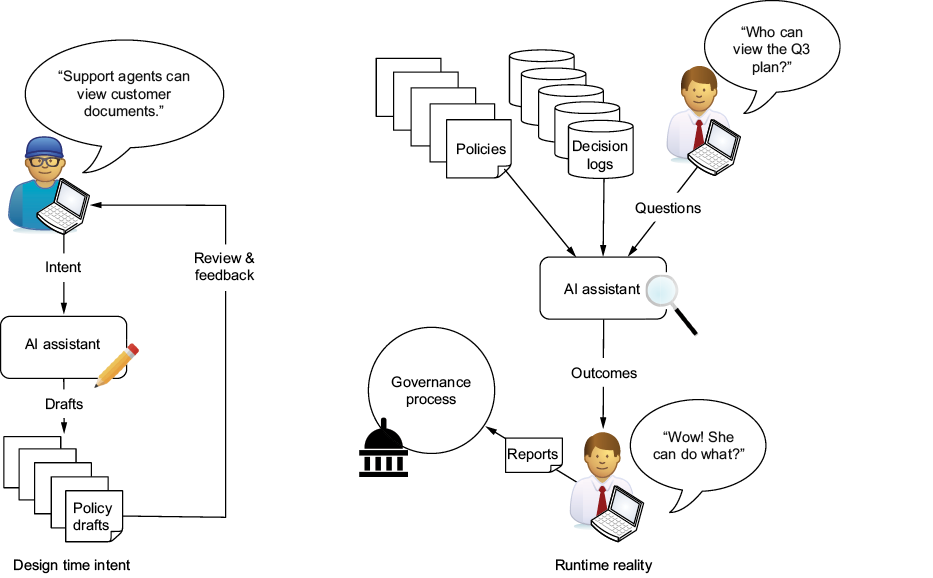
Compare policy intent at design time with authorization decisions observed at runtime to identify mismatches and guide governance review. section 17.3
