When authorization rules spread across applications, teams get inconsistent behavior and decisions that are difficult to change or explain. A policy service externalizes a coherent set of related authorization decisions so multiple systems can use shared decision infrastructure. section 19.5 section 19.6
Organizations commonly move from local application logic to coordinated policy externalization and contextual decisions, then toward strategic infrastructure for delegation, automation, and digital trust. A policy service supports that progression without requiring a complete redesign. section 19.5
Use a policy service incrementally:
- Start with one visible access problem, such as document sharing, a partner API permission, or an internal approval workflow. section 19.6
- Externalize one high-value decision into a shared policy service, then reuse the resulting patterns and practices. section 19.6
- Around third-party platforms, enforce policy through gateways or integration layers, normalize identity and context signals, and favor clear delegation, audit logs, policy APIs, and fine-grained controls. section 19.6
Document-sharing authorization
A difficult-to-change document-sharing rule becomes a focused policy domain. Externalizing it into a shared policy service delivers immediate value while establishing patterns that can be reused for other authorization decisions. section 19.6
Figure 19.3 Authorization maturity spectrum. The maturity spectrum generalizes the pattern illustrated by ACME’s journey in figure 19.2. Organizations often progress from local, embedded decision logic to coordinated policy externalization and then to a strategic authorization architecture. Each stage strengthens the organization’s ability to manage growing decision surfaces, incorporate context, govern delegation, and make consistent authorization decisions at runtime.
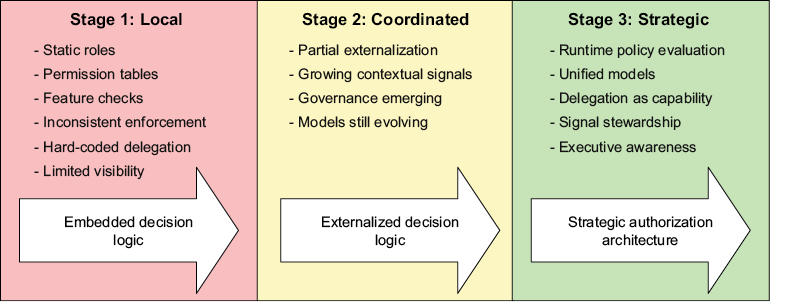
Use the maturity spectrum to compare embedded decision logic, coordinated policy externalization, and strategic authorization architecture. section 19.5
Table 19.1 Incremental steps toward strategic authorization. Organizations can enhance authorization capabilities by making targeted changes to address immediate challenges. Each step builds on existing practices, gradually strengthening decision infrastructure and governance without requiring a complete overhaul.
| If you are here |
You’re likely seeing |
A practical next step |
|---|---|---|
| Authorization logic embedded in applications |
Inconsistent behavior across systems; hard-to-change rules |
Externalize one high-value decision into a shared policy service. |
| Multiple policy mechanisms across teams |
Duplicate logic; outcomes that are difficult to reason about |
Standardize on a common policy model and evaluation approach. |
| Growing use of contextual signals |
Ad hoc use of attributes; unclear trust in signals |
Define ownership, freshness, and assurance requirements for key signals. |
| Increasing delegation (partners, automation, agents) |
Workarounds, over-permissioning; manual approvals |
Introduce explicit delegation models with bounded scope. |
| Policy decisions difficult to explain or audit |
Support escalations; compliance friction |
Capture and analyze decision logs to improve visibility and confidence. |
| Policy changes risky or slow |
Fear of breaking behavior; heavy review processes |
Introduce testing, simulation, and staged rollout for policy changes. |
| Organization recognizes authorization as strategic |
Cross-team alignment; executive interest |
Establish shared ownership between product, identity, and security teams. |
Use the incremental-steps table to map inconsistent authorization, fragmented policy mechanisms, and contextual-signal growth to practical next actions. section 19.6
