A business outcome is an observable organizational result produced by an initiative, product, or capability. For platform engineering, it is the endpoint that gives technical improvements business meaning: faster time-to-market, greater reliability, higher developer satisfaction, stronger competitiveness, or measurable cost savings. section 10.1.1 section 10.8
Connect platform capabilities to outcomes through an evidence chain:
- Measure adoption to establish whether teams and developers find the platform relevant and useful. section 10.1.1
- Track productivity through DORA metrics to show changes in delivery speed and operational efficiency. section 10.1.1
- Assess quality through incidents, failures, defects, and customer trust signals. section 10.1.1
- Validate the endpoint with revenue, customer satisfaction, market competitiveness, time-to-market, or cost savings. section 10.1.1 section 10.8
Platform launch evaluation
A platform team should not treat successful deployment, adoption, or engineering efficiency as the final result. Those measures are leading indicators. The launch is successful only when the platform’s improvements contribute to the organization’s intended business outcomes. section 3.1.4
Figure 10.1 Quantifying the value across multiple levels, from building the capabilities to addressing the business outcomes
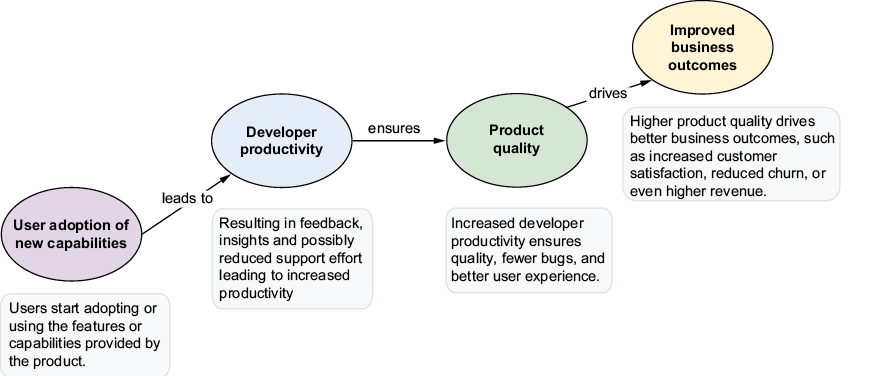
Trace value from platform capabilities through adoption, productivity, quality, and reliability measures to business outcomes. section 10.1.1




