A measurement outcome is the classical bit string produced when qubits are measured. Unlike a classical readout, it is generally probabilistic: measuring a superposition returns one possible basis-state result, not a complete description of the quantum state. Measurement also changes the state, so an algorithm must arrange for the needed information to be extractable at its final measurement. section 4.0
For computational-basis measurement, a qubit in α|0⟩ + β|1⟩ yields outcome 0 with probability α² and 1 with probability β² when the amplitudes are real. More generally, each multiqubit basis-state outcome has probability equal to the squared amplitude of that state. A system already in a basis state produces its matching outcome with certainty. section 4.1.1
Figure 4.2 Measuring two qubits in a superposition of all basis states can give any of the results 00, 01, 10, and 11, with probabilities equal to squares of the amplitudes of the corresponding basis states in the superposition state. When we measure a system that is in a specific basis state, we can only get the result that corresponds to that state, with 100% probability.
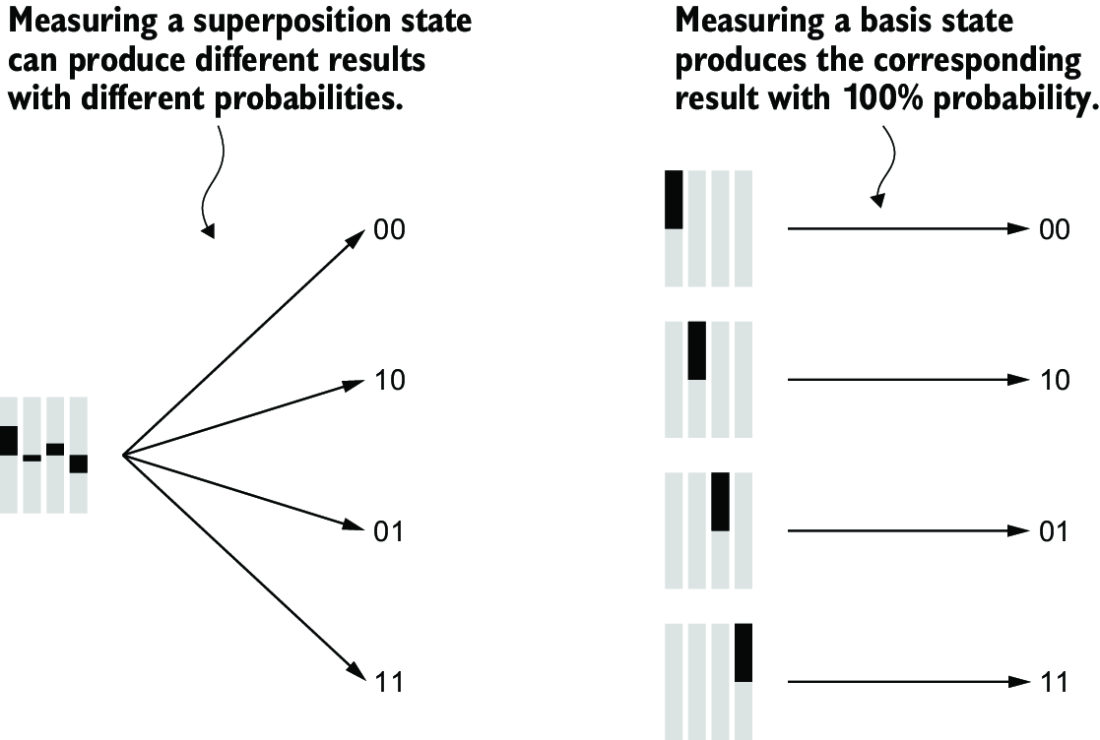
Use the two-qubit outcome diagram to connect each possible bit string to its basis-state amplitude and probability. section 4.1.1
Treat outcomes as classical data after circuit execution:
- Measure each qubit into a corresponding classical bit. In Qiskit, the circuit contains both the qubit register and the classical register that receives results. section 4.1.2
- Run repeated shots and inspect get_counts output, whose keys are measured bit strings and whose values count their occurrences. section 4.1.2
- Interpret the bit string in classical code when the task requires an answer beyond the raw measurement result. section 4.2.2
Identifying a state from its outcome
Suppose one of four three-qubit superposition states is prepared, with no basis state shared between them. Measuring all qubits yields a basis-state bit string belonging to exactly one candidate, so the result can be mapped to that candidate’s index. For example, 000 or 111 identifies (|000⟩ + |111⟩)/√2. This works because measurement cannot produce a basis state absent from the prepared superposition. section 4.2.1 section 4.2.2
Outcome labels depend on the chosen measurement basis. To distinguish two possible states, assign outcomes 0 and 1 to orthogonal measurement-basis states, then use the observed label to choose a guess. The basis can be selected to maximize the probability that this outcome-based decision is correct. section 4.4.1
In a Qiskit circuit, a measurement outcome is the circuit’s direct classical result rather than an arbitrary computed return value. Design the final state so outcome labels match the alternatives being distinguished, or account for their mapping during later classical analysis. section 5.1.2




