Classical post-processing interprets quantum-computation results, converts them into a final solution, or decides which calculation should run next. section 7.0 section 7.4
Post-processing commonly performs the following tasks:
- Format quantum outputs for human-readable presentation. section 7.0
- Formulate the next iteration of an iterative algorithm. section 7.0
- Validate a probabilistic quantum answer using a classical computation. section 7.4
Grover search
After Grover’s algorithm produces a candidate x₀, calculate the classical function f(x₀) and accept the candidate only when f(x₀) = 1. In Shor’s algorithm, post-processing turns a discovered period into the factors of the input number. section 7.4 section 7.0
Figure 7.2 A quantum algorithm can combine classical and quantum computations. Typically, it starts with a classical data preprocessing step that prepares input data for the quantum computation and passes it to the quantum subroutine. The results of the quantum computation are then fed into another classical step, postprocessing, that converts them into the final problem solution. Some of these steps can be omitted for simple algorithms or repeated with some variation for iterative algorithms.
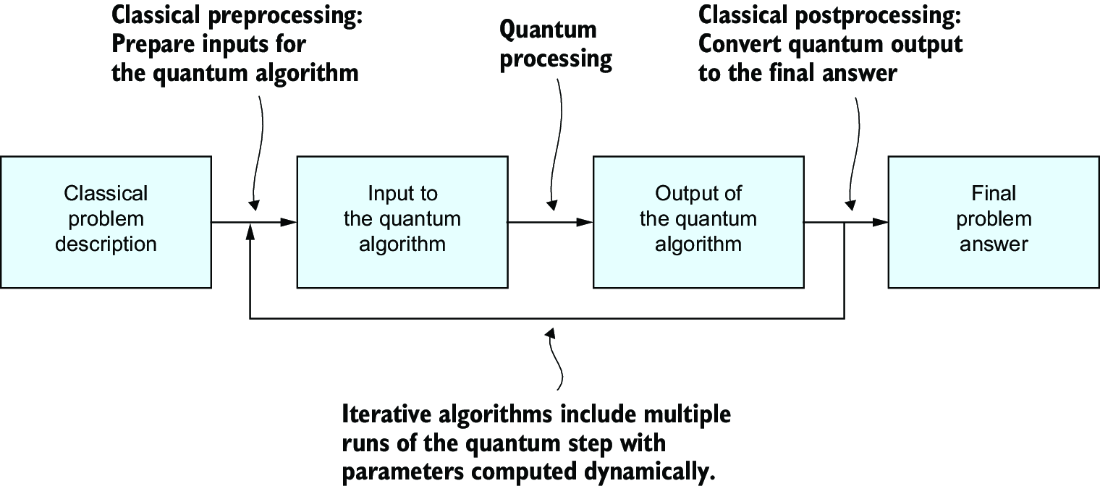
Use the workflow diagram to place post-processing after the quantum subroutine and alongside optional repeated classical steps. section 7.0



