Post-training refines a pretrained language model after next-token learning, improving instruction following, human-preference alignment, or reasoning behavior without rebuilding the model from raw text. section 1.2 section 1.5
A common workflow applies instruction fine-tuning, reasoning training, and preference tuning after pretraining, although stages may be reordered, interleaved, or selectively skipped. section 1.2 section 6.1
Post-training methods serve distinct engineering goals:
- Instruction fine-tuning makes responses follow user prompts more directly. section 1.2
- Preference tuning improves qualities such as tone, engagement, and alignment with human preferences. section 1.2
- Reinforcement learning strengthens reasoning-like behavior through action outcomes, with reasoning training and preference tuning as common stages. section 1.5 section 6.1
One prompt across training stages
For a sleep-and-health summary, a pretrained model gives a relevant but unfocused answer; instruction tuning produces a concise response, while preference tuning adds a friendly, engaging tone. section 1.2
Figure 1.3 Overview of a typical LLM training pipeline. The process begins with a model initialized with random weights, followed by pretraining on large-scale text data to learn language patterns by predicting the next token. Post-training then refines the model through instruction fine-tuning and preference fine-tuning, enabling the LLM to better follow human instructions and align with human preferences.
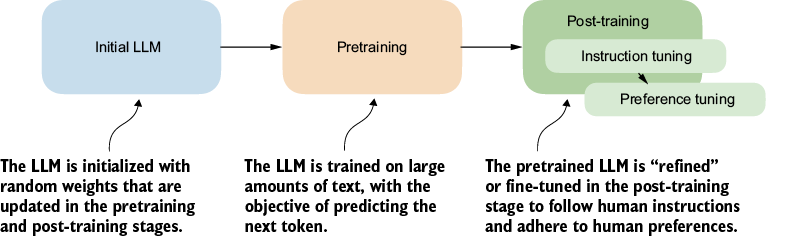
Use the pipeline diagram to trace how pretraining leads into instruction fine-tuning and preference fine-tuning. section 1.2


