Post-training is the many-stage optimization and adaptation process applied after pretraining to turn a next-token language model into a more useful model for downstream interactions. It cultivates capabilities already latent in a base model while reshaping outputs toward instruction following, preferred style, format, and task performance. section 1.1 section 1.4
Rather than one algorithm, post-training combines methods selected for different signals. Instruction fine-tuning (SFT or IFT) teaches the instruction–response format; preference fine-tuning aligns outputs with human preferences; and reinforcement learning with verifiable rewards (RLVR) targets domains whose correctness can be checked. RLHF is a major part of preference fine-tuning, not the entirety of post-training. section 1.1 section 1.7
A practical post-training pipeline can include:
- Instruction fine-tuning on curated instruction–response examples, with chat templates and loss masking that train assistant responses rather than user prompts. section 4.4
- Preference-data collection, ideally from generations of a recent checkpoint so comparisons reflect the model behaviors being optimized. section 11.2
- Preference optimization through a learned reward model and policy gradients, rejection sampling, or direct alignment algorithms trained from pairwise preferences. section 3.1.5
- RLVR runs on verifiable tasks such as mathematics, used to boost targeted skills while preserving broader performance. section 3.2.2
From completion to assistance
A raw model may continue a factual prompt with unrelated web-like metadata. A model shaped with RLHF and other post-training methods instead gives a concise answer. The same process can change interpersonal behavior: a blunt response to presentation anxiety can become a supportive response with concrete advice. These changes concern style, tone, and answer format, while post-training can also affect benchmark performance. section 1.2 section 1.7
Figure 3.7 A summary of the Tülu 3 recipe with target skills and multistep training recipe. Lambert et al. 2024, license CC-BY.
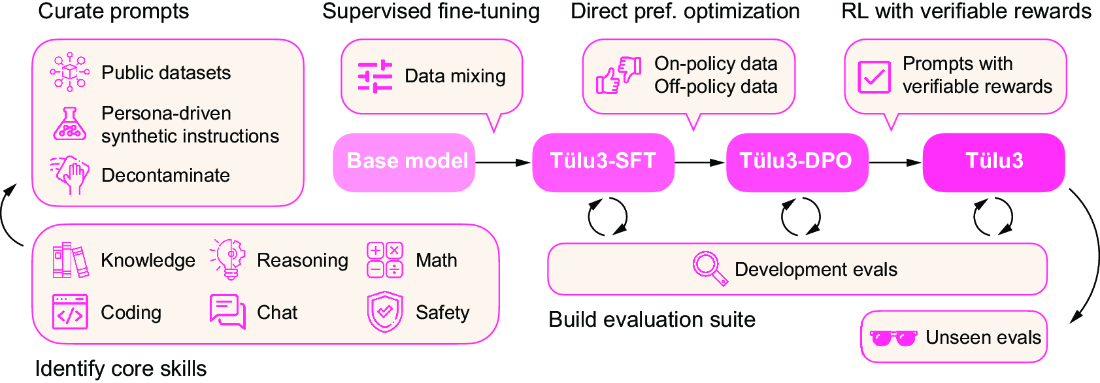
This multistage recipe connects large-scale instruction tuning, on-policy preference data, and a smaller RLVR stage to distinct target behaviors and skills. section 3.2.2
Recipes have expanded from the early SFT–reward-model–RL sequence into iterative pipelines with many checkpoints, larger synthetic datasets, and specialized training runs. Synthetic data can generate prompts and completions, supply AI feedback, or filter candidates; quality filters, diversity, deduplication, and mixing human data help avoid degraded generalization from repetitive self-training. section 3.2.1 section 12.1
Optimization choices carry trade-offs. Preference optimization uses imperfect proxy signals for human values, and over-optimization can produce excessive length or chattiness that harms performance elsewhere. Evaluation must also match the trained interaction format: prompt-format mismatches can sharply reduce scores, while differing prompts, sampling settings, and contamination make cross-system rankings approximate. section 1.7 section 16.6


