When a startup raises a priced seed round, investors need a value for the company before their cash arrives. That agreed value is the pre-money valuation. section 10.0 section 10.4
Pre-money means the company’s value immediately before the new capital raise. It excludes the investment that is about to be added; the value immediately afterward is the post-money valuation. section 10.4
Investors may judge a young company’s pre-money valuation using:
- Team size and the company’s stage. section 10.4
- Intellectual property already developed. section 10.4
- Comparisons with similar companies, when useful. section 10.4
- Product or service progress, including whether the startup is acquiring customers. section 10.4
A seed-round example
Suppose a startup is already acquiring customers. Investors might agree on a $1.5 million pre-money valuation and invest $1 million. Adding the new cash gives a $2.5 million post-money valuation. At this risky stage, investors may seek roughly 30% to 40% ownership. section 10.4
Figure 10.1 Pre- and post-money valuations for a sample seed and Series A. Values are in millions, except price per share.
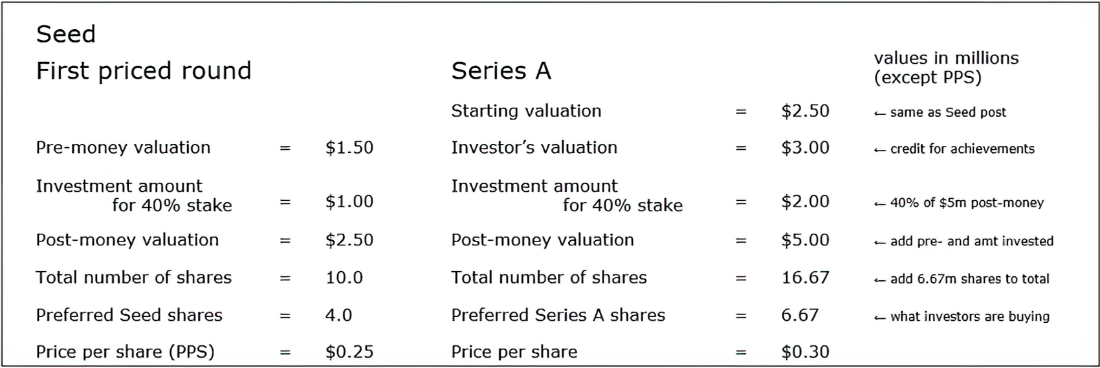
Use the valuation figure to compare pre-money and post-money values across a sample seed and Series A financing. section 10.4
A post-money valuation can feel like a floor, but it is not guaranteed: losing customers, product failure, or a departing CEO can reduce the company’s value. section 10.4
