A reward model is a separate model that scores and ranks outputs according to human judgments of quality and relevance. It converts preferences such as domain expertise, factual accuracy, or successful code execution into quantitative feedback for improving a language model. section 9.5.3 section 9.7
A reward model supports the RLHF workflow:
- Use an SFT model to generate multiple responses for each prompt. section 9.5.3
- Have human evaluators rank responses using criteria such as expertise, fact-checking, or code execution. section 9.5.3
- Train the reward model to predict those quality judgments and score new outputs. section 9.5.3 section 9.7
- Use its scores to further train the SFT model, often with PPO, producing an RLHF-aligned model. section 9.5.4 section 9.7
Support-response alignment
For a customer-support prompt, an SFT model generates several replies. Evaluators rank them for factual accuracy and relevance; the reward model learns these preferences and scores later replies so reinforcement learning can favor stronger responses. section 9.5.3 section 9.5.4
Figure 9.16 RLHF fine-tuning approaches to aligning language models [13]
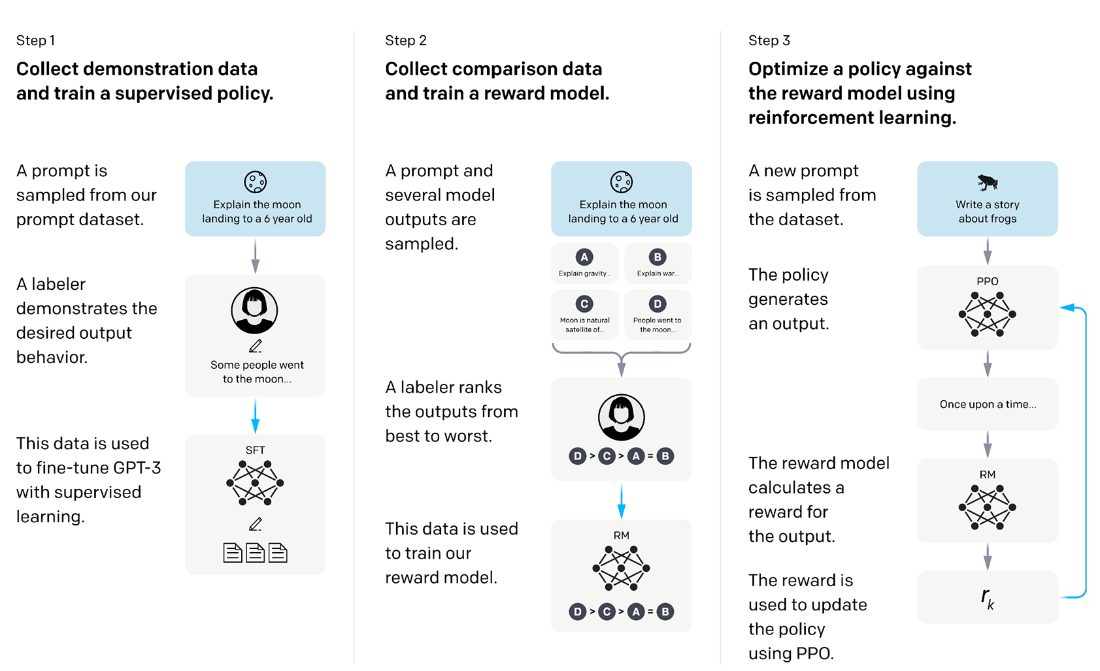
Use the RLHF workflow diagram to trace how supervised fine-tuning, reward modeling, PPO, and human feedback work together. section 9.7




