A reward model is a learned model that scores outputs or actions according to preference feedback. In RLHF, it supplies the preference signal used to fine-tune a language model’s policy toward human intent. section 5.2 section 5.1
The model can be trained for a specific task or adopted from a pretrained version. Reinforcement learning then adjusts the policy to maximize its scores, linking preference modeling to policy optimization. section 5.2
Reward models appear in several preference-alignment workflows:
- RLHF uses an explicit reward model as a foundational component for optimizing the language-model policy. section 5.2
- DPO removes the separate reward-model stage and directly optimizes the language model from preferred and less-preferred responses. section 5.2
- GRPO uses a reward model to score multiple completions, then compares scores within each prompt group instead of relying on a separate value function. section 5.2.5
Structured-completion rewards
A GRPO workflow can score completions according to whether they contain meaningful <think> and <answer> sections: complete structure receives full reward, partial structure receives partial reward, and invalid structure receives none. section 5.2.5
Figure 5.1 A simplified comparison of RLHF and DPO and how DPO directly optimizes for the policy without an explicit reward function
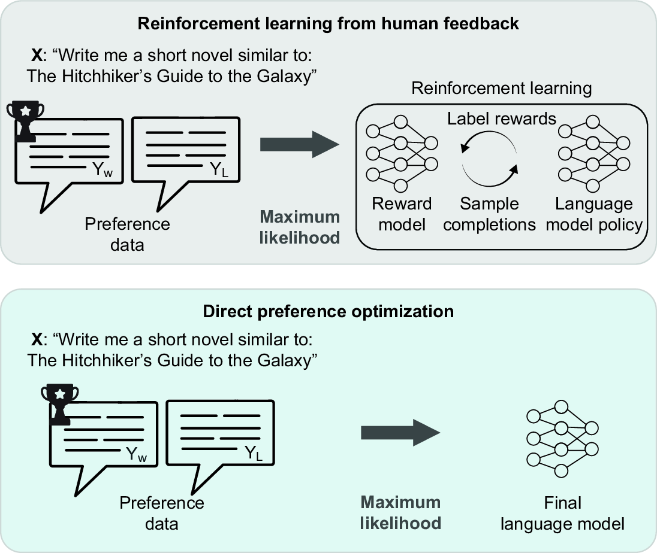
Compare RLHF’s explicit reward-model pathway with DPO’s direct policy optimization. section 5.2




