Preference tuning is a post-training step that refines an instruction-tuned model toward preferred response styles and behaviors. It follows pretraining and supervised fine-tuning: instruction tuning improves task following, while preference tuning adjusts how answers are expressed. section 1.2 section 1.8
A common implementation, reinforcement learning with human feedback (RLHF), proceeds in two stages:
- Collect human rankings for multiple candidate responses to the same prompt. section 6.1.1
- Train a reward model to assign preference scores to responses. section 6.1.1
- Use those scores in an RL objective to update the target model, encouraging preferred outputs and discouraging less desirable ones. section 6.1.1
Choosing a programming laptop
Given a prompt about buying a laptop for programming and everyday use, annotators may prefer a concrete recommendation about CPU, RAM, SSD, keyboard, battery, and GPU relevance over a broader checklist. Repeated rankings teach the model to favor specificity and usefulness for the stated use case. section 6.1.1
Figure 6.5 A two-stage overview of reinforcement learning with human feedback (RLHF). First, a reward model is trained on human-ranked responses to assign a preference score to each. Second, the LLM is updated using these reward scores within an RL objective to encourage preferred responses and discourage less desirable ones.
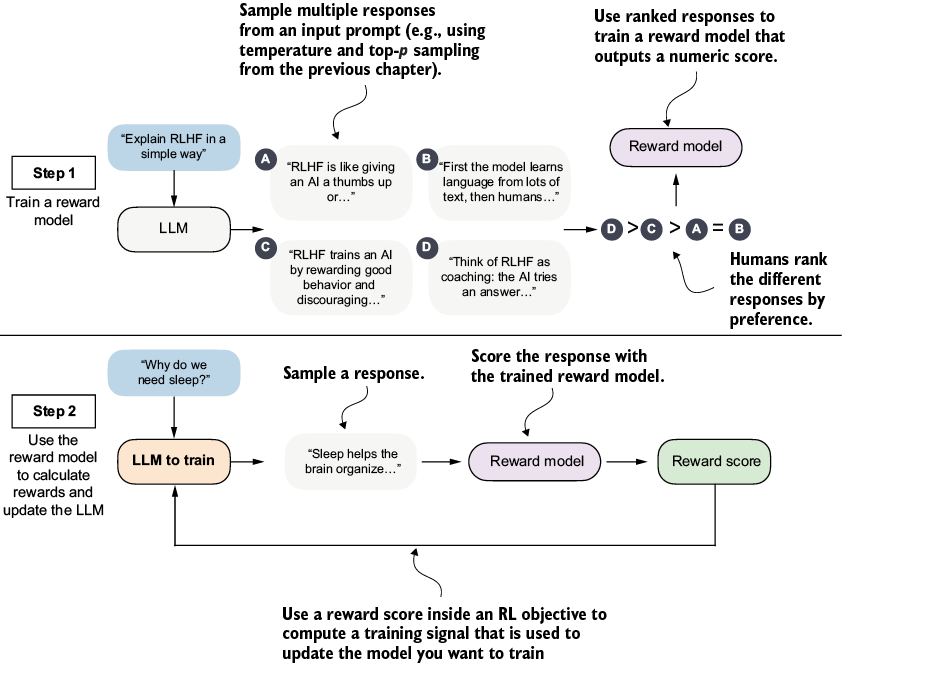
Use the two-stage RLHF workflow to trace how human-ranked outputs become reward scores and then model updates. section 6.1.1

