Pretraining is the initial phase of building a large language model (LLM). The model learns foundational language patterns and information from an enormous corpus before receiving task-specific refinement. section 2.1 section 2.16
For generative models, pretraining typically uses autoregressive, or causal, token prediction: given previous tokens, the model learns to predict the next word or character. This self-supervised process does not require task-specific labels. section 2.1
Pretraining establishes broad capabilities while also carrying limitations from its data:
- It builds internal representations that support question understanding, contextual interpretation, and closed-book answers from learned information. section 2.2
- It usually draws on open-web material, including public pages from sources such as Wikipedia, Reddit, blogs, news aggregators, and forums. section 2.2
- Its coverage is uneven: English and topics common in the corpus receive stronger representation, while obscure information can produce incorrect or fabricated answers. section 2.2
- Pretraining is followed by post-training, which can target dialogue, instruction following, code generation, or mathematical problem solving. section 2.1 section 2.16
A learned assumption
When asked, “Who was the first president?” an LLM may answer George Washington, implicitly interpreting the question as referring to the United States. That response reflects patterns and geographic imbalances present in its pretraining data, not guaranteed universal understanding. section 2.2
Figure 2.1 The high-level training process for LLMs
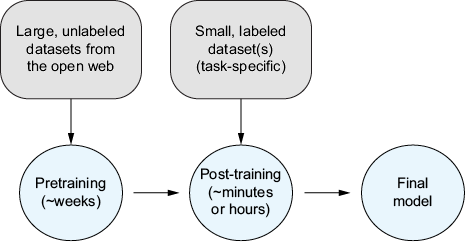
Use the high-level training-process figure to distinguish pretraining from the later post-training stages that specialize model behavior. section 2.1













