Pretraining gives a language model broad linguistic and world knowledge by teaching it to predict words from surrounding context. That foundation can produce correct English without producing a useful conversational response. section 5.1.2 section 5.1.3
The objective is deliberately raw: the model generates the next word from preceding, and potentially following, words. Afterward, it can be adapted to specialized tasks, but pretraining alone does not teach user intent or a particular interaction style. section 5.1.2 section 5.1.3
Pretraining matters when planning an AI product because it helps distinguish foundation capabilities from later customization:
- Expect general language competence and world knowledge, not necessarily helpful conversation. section 5.1.3
- Treat conversational behavior as a separate adaptation problem, illustrated by the contrast between Mistral and ChatGPT. section 5.1.2
- Use the distinction to discuss customization, user experience, delivery costs, and risks with technical teams. section 5.1.2
Mistral versus ChatGPT
Given “Hey, I am super excited about working with you and trying new stuff!”, a raw language-model objective can yield correct English that stops awkwardly. A conversationally fine-tuned model instead continues with a soothing, complete interaction. section 5.1.2 section 5.1.3
Figure 5.3 The objective of language modeling is to predict words based on their context.
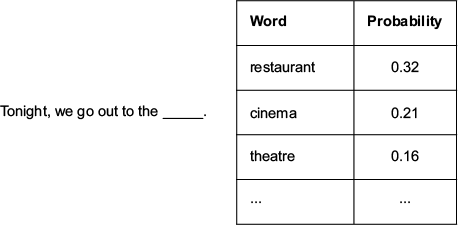
Use the contextual word-prediction diagram to see how pretraining turns surrounding words into the model’s basic generation objective. section 5.1.2













