Pretraining gives a model a broad starting point before task-specific adaptation. Training on a large corpus such as Wikipedia, books, or the internet helps an LLM learn language patterns, syntax, semantics, and world knowledge. section 5.2.2
The trade-off is substantial cost: pretraining requires many iterations and significant computation, while later finetuning usually uses much less data and fewer resources. Reusing a pretrained model is therefore often more practical than training from scratch. section 5.2.2
Pretraining establishes the foundation for later model work:
- Learns broad language patterns from a large, diverse corpus. section 5.2.2
- Provides a reusable model for tasks such as sentiment analysis, text classification, and question answering. section 5.2.2
- Supports an end-to-end workflow that can continue through quantization, LoRA finetuning, and production deployment. section 9.0
From broad training to a specialized model
A model can first learn from a general corpus, then adapt to a specific domain or task. A practical project follows this pattern by pretraining a model from scratch, making production-oriented improvements, applying LoRA, and serving it at an endpoint. section 5.2.2 section 9.0
Figure 5.3 Finetuning differs from training from scratch in that you don’t have to define model behavior, you can use the exact same training loop, and you have a fraction of the data requirement.
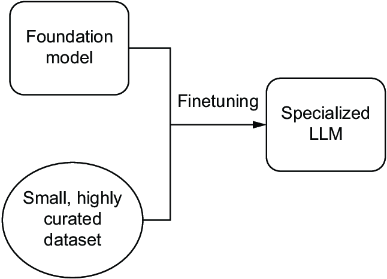
Compare pretraining with finetuning through data requirements, model-behavior definition, and reuse of the training loop. section 5.2.2













