A primary server is an NTP server that obtains time directly from a reference clock, such as an atomic or GPS clock. It is stratum 1: reference clocks are stratum 0. Unlike a secondary server, it is not an NTP client of the reference clock; specialized hardware and protocols provide synchronization. section 2.4 section 2.2
Figure 2.2 The NTP hierarchy. Reference clocks (stratum 0) are high-precision timekeeping devices such as atomic clocks. Stratum 1 NTP servers connect directly and sync to reference clocks. Stratum 2 NTP servers sync to stratum 1 NTP servers. Servers can peer with devices at the same stratum.
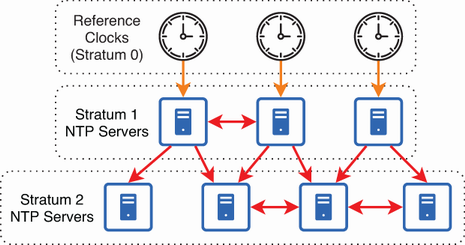
Use the NTP hierarchy to distinguish stratum 0 reference clocks, stratum 1 primary servers, and higher-stratum secondary servers. section 2.2
Use these distinctions when interpreting NTP designs and verification output:
- Identify a server with a direct reference-clock connection as primary and stratum 1. section 2.4
- Classify a server that learns time from another NTP server as secondary; secondary servers operate as both clients and servers. section 2.2
- Read the st column in show ntp associations to determine a configured server’s stratum; a primary server appears as stratum 1. section 2.3.1
- Expect a Cisco router synchronized to a stratum 1 primary server to report itself as stratum 2 with show ntp status. section 2.3.1
Cisco IOS fallback primary server
Use ntp server first to synchronize with external servers tied to accurate reference clocks. Add ntp master when the router needs an internal-clock fallback: R1(config)# ntp master. The router then adds 127.127.1.1 as a local time source, shown at stratum 7 by default; ntp master 5 specifies a local-clock stratum of 4. This fallback is less accurate but can preserve consistent time for downstream clients when external servers are unavailable. section 2.3.2
