A secondary NTP server learns time from another NTP server instead of directly from a reference clock. It therefore acts as both an NTP client and an NTP server. A stratum 2 server typically synchronizes with stratum 1 and can serve stratum 3 clients. section 2.4 section 2.2
Operational facts:
- Configure a Cisco IOS device with ntp server ip-address [prefer]; the device becomes a client of that server while remaining available as a server for downstream clients. section 2.4
- Use multiple NTP servers for redundancy, fault tolerance, and better time selection; the device can compare reports and discard outliers. section 2.2
- Verify sources with show ntp associations and inspect local synchronization and stratum with show ntp status. section 2.4 section 2.3.1
- A secondary server’s stratum is one greater than its upstream server’s stratum; a device synchronized to stratum 1 reports stratum 2. section 2.3.1
Cisco IOS configuration and verification
R1(config)# ntp server 216.239.35.0 prefer R1(config)# ntp server 20.43.94.199 R1(config)# do show ntp status Clock is synchronized, stratum 2, reference is 216.239.35.0 The prefer keyword favors one configured source. R1 is a secondary server because it synchronizes to an upstream stratum 1 server while potentially serving downstream clients. section 2.3.1
Figure 2.2 The NTP hierarchy. Reference clocks (stratum 0) are high-precision timekeeping devices such as atomic clocks. Stratum 1 NTP servers connect directly and sync to reference clocks. Stratum 2 NTP servers sync to stratum 1 NTP servers. Servers can peer with devices at the same stratum.
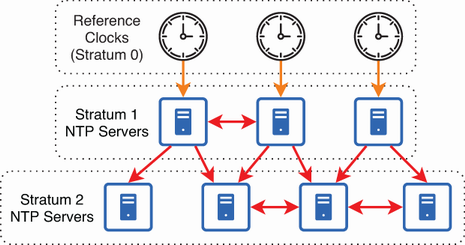
Browse the NTP hierarchy from reference clocks through primary and secondary servers, including same-stratum peer relationships. section 2.2
