Least-privilege access grants each identity or process only the permissions required for authorized tasks. It becomes non-negotiable when weak security boundaries could expose sensitive data, create legal consequences, or produce hard-to-detect harm. section 3.5
Treat least privilege as an operable control rather than a one-time design claim:
- Review permissions periodically, especially where identities, processes, or storage cross security boundaries. section 3.5
- Increase rigor when permission failures can remain hidden, affect sensitive data, or create financial, legal, or operational damage. section 3.5
- Balance the control against delivery cost, but do not treat high-consequence access risks as acceptable imperfection. section 3.5
Figure 3.4 Not every architectural concern deserves the same level of rigor. Good architects distinguish between areas that can absorb compromise and those where failure is unacceptable.
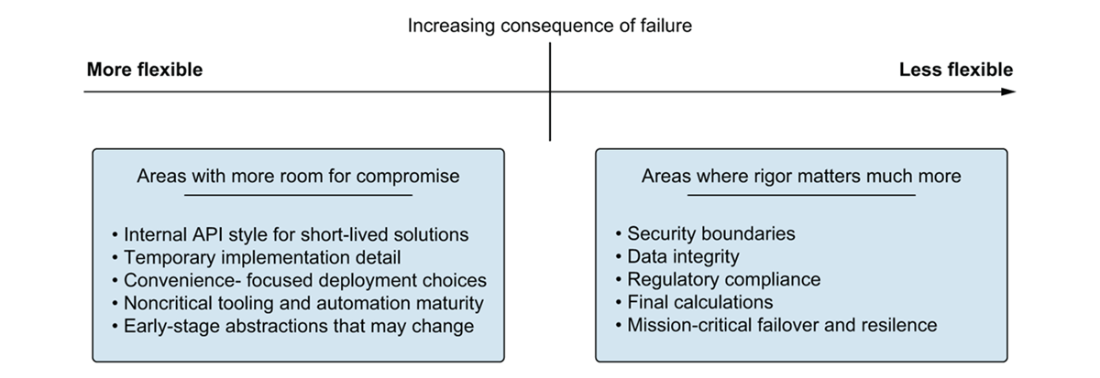
Use the rigor distinction to decide where permission controls require stronger safeguards and operational proof. section 3.5





















