A prior probability represents an initial belief about an unknown quantity before observations are incorporated. It need not be precise: a broad range such as a house price between $150,000 and $300,000 expresses uncertainty without favoring one value strongly. section 2.1
Bayesian reasoning updates a prior using the likelihood of observed data, producing a posterior probability. Relevant evidence can narrow or shift the belief, while unrelated evidence may leave it unchanged. section 2.1 section 3.1
The same evidence can produce different posteriors because people begin with different priors:
- After a carnival performer guesses numbers correctly 100 times, observers reach different conclusions about whether the performer is psychic. section 3.1
- A prior probability of zero remains zero after repeated successful guesses, while a larger initial prior increases more quickly. section 3.1
- For a phone dropped from a ten-story building, an exponential prior assigns probability 1/2 to the first floor and progressively smaller probabilities to higher candidate floors. section 6.3.1
Choosing an informative search
Suppose the unknown X is the highest safe drop floor. A uniform prior makes splitting the possible floors in half optimal for information gain. An exponential prior instead reflects engineering knowledge that lower floors are more likely, changing the best trial decision. section 6.3.1
Figure 2.2 Bayes' theorem, which gives a method of updating a belief about a quantity of interest, represented as a probability distribution of a random variable. Before observing any data, we have the prior belief about X. After being updated with data, we obtain the posterior belief about X.
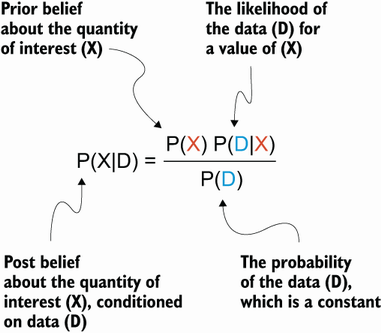
Bayes’ theorem can be viewed as transforming a prior distribution into a posterior distribution after data is observed. section 2.1







