A probabilistic AI system generates outputs by predicting what is likely to fit the training data and the prompt’s context. Unlike a deterministic system, it can produce different results for the same input; variation is intentional rather than a malfunction. section 1.3
A practical interaction follows this loop:
- Provide a prompt and relevant context. section 1.3
- Review the model’s probable code or answer. section 1.3
- Accept, modify, or reject the suggestion, using developer judgment to guide the next iteration. section 1.3
Deterministic calculation versus generated output
A calculator returns exactly 4 for 2 + 2 because fixed rules determine the result. A generative AI system may respond differently to the same request, because its output is probabilistic and designed to produce something new. section 1.3
Figure 1.1 Integrated tools use a sophisticated system to generate code. The process starts with your prompt, and the assistant gathers up documentation and source code to see whether your answer can come from these sources. It makes a best guess at what you’re looking for and generates a response. Your acceptance of these responses helps train the assistant in the future (unless you’ve blocked feedback).
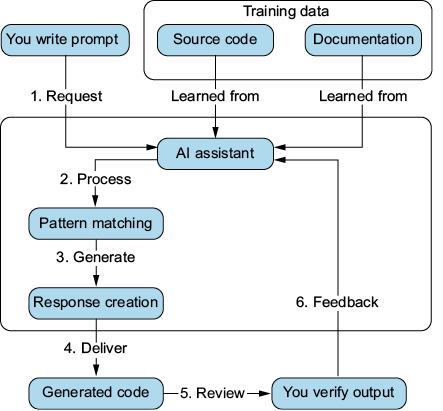
Trace how an integrated tool moves from a prompt to gathered documentation and source code, makes a best guess, generates a response, and uses feedback for later adaptation. section 1.3
