liveBook · Manning

Problem definition

As explained in Machine Learning Platform Engineering

Problem formulation is the process of translating a real-world objective into a precisely defined machine learning problem with suitable inputs, outputs, and success criteria.

Problem definition translates a real-world objective into a precise machine learning problem with suitable inputs, outputs, evaluation criteria, and operational constraints. It starts the ML life cycle and must align stakeholders before data collection or model development begins. section 2.1 section 2.0

A production-ready definition answers questions across three stakeholder groups:

  • Business and product teams clarify the task, reason for using ML, success metrics, business value, timeline, error tolerance, and impact of incorrect predictions. section 2.1
  • Technical teams assess whether ML is appropriate, identify available data and pipeline needs, choose evaluation metrics, estimate compute, and plan deployment and retraining. section 2.1
  • Legal and compliance teams address ethics, privacy, sensitive information, and data-governance requirements. section 2.1

From vague goal to defined problem

“Predict the churn rate of customers” is insufficient by itself because it does not establish the task details or evaluation criteria. A vehicle-price system instead connects prediction to customer needs, business value, evolving data, and future model versions. section 2.1

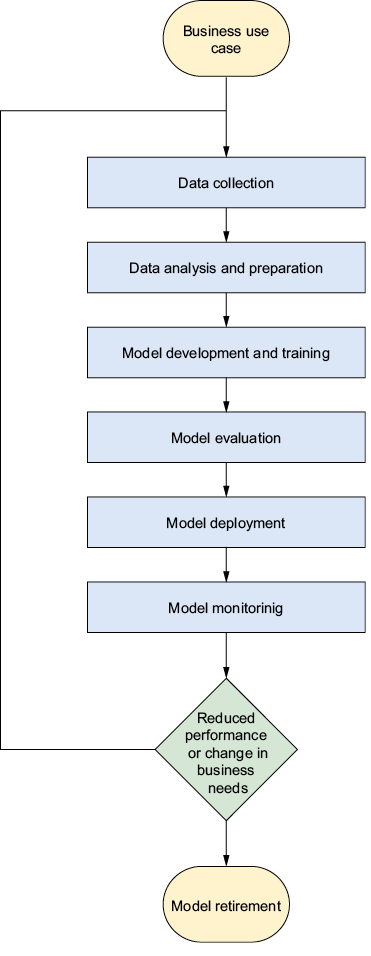
Figure 2.2 ML as a loop
A collage of a cell phone with a hand holding a passport

AI-generated content may be incorrect.

Use the ML-as-a-loop figure to place problem definition at the start of an iterative workflow that continues through data, modeling, deployment, and improvement. section 2.1
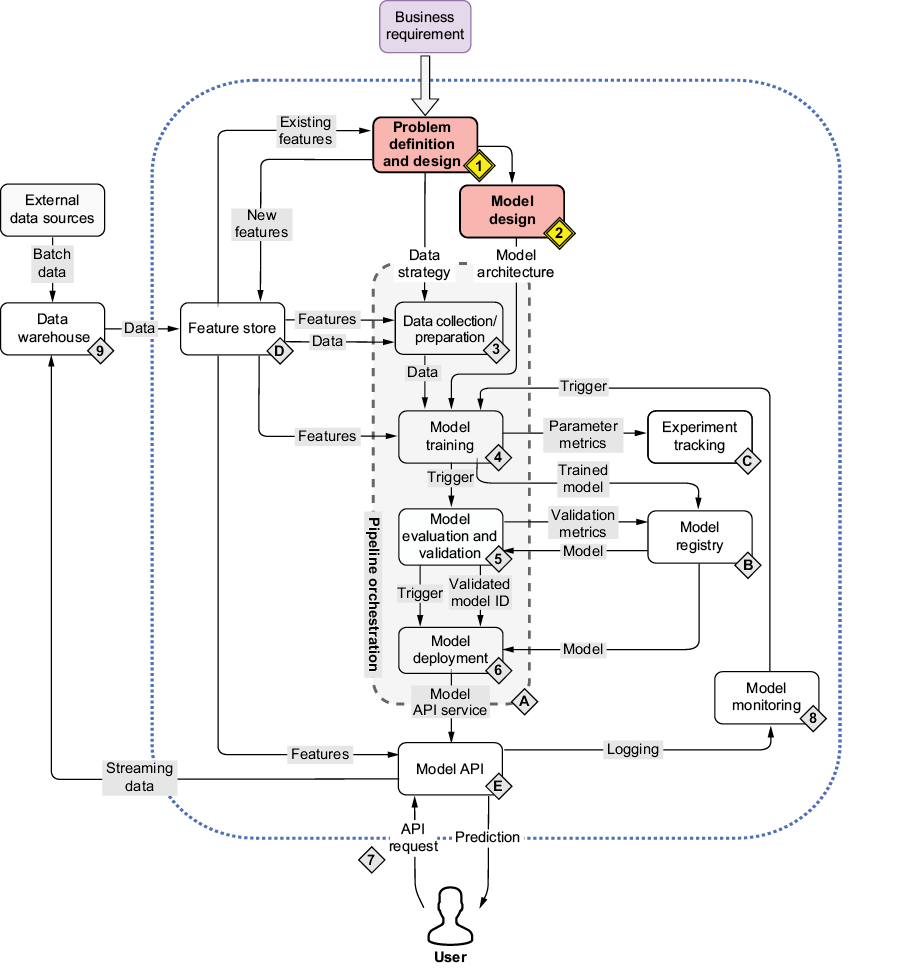
Figure 2.1 The mental map focusing on defining the problem (1) and designing the model (2)
A screenshot of a computer

AI-generated content may be incorrect.

Use the mental map to connect defining the problem with model design and the input requirements that constrain later development. section 2.0


How Machine Learning Platform Engineering covers it

How deep it goes
Provides a stakeholder question set and lifecycle placement, but stops short of specifying implementation algorithms or code.
Examples
Contrasts vague customer-churn prediction with vehicle-price prediction and uses stakeholder questions as a practical checklist.
What it assumes
Assumes a real-world objective and stakeholder participation while introducing the ML life cycle and production-system context.
What you can do after
Apply it by aligning stakeholders on the task, success metrics, data, risks, deployment approach, and retraining signals.
How it connects
Connects the ML life cycle, data collection, model design, evaluation, deployment, retraining, and data governance.

Also explained in

Compare how 6 books explain problem definition →

Related concepts

This explainer was generated by Manning's knowledge graph from the text of Machine Learning Platform Engineering. The section links point to the parts of the book it draws on.



