Before building a reinforcement learning system, decide whether the problem calls for reinforcement learning at all. Framing comes first: a sound algorithm cannot compensate for a poorly chosen problem or system design. section 12.2
RL is justified when all four conditions hold:
- Decisions are sequential. section 12.2
- Feedback is delayed. section 12.2
- Randomness requires the agent to generalize rather than memorize. section 12.2
- Learning from consequences over time matters. section 12.2
Figure 12.2 Where the work and the risk really sit in an RL system.
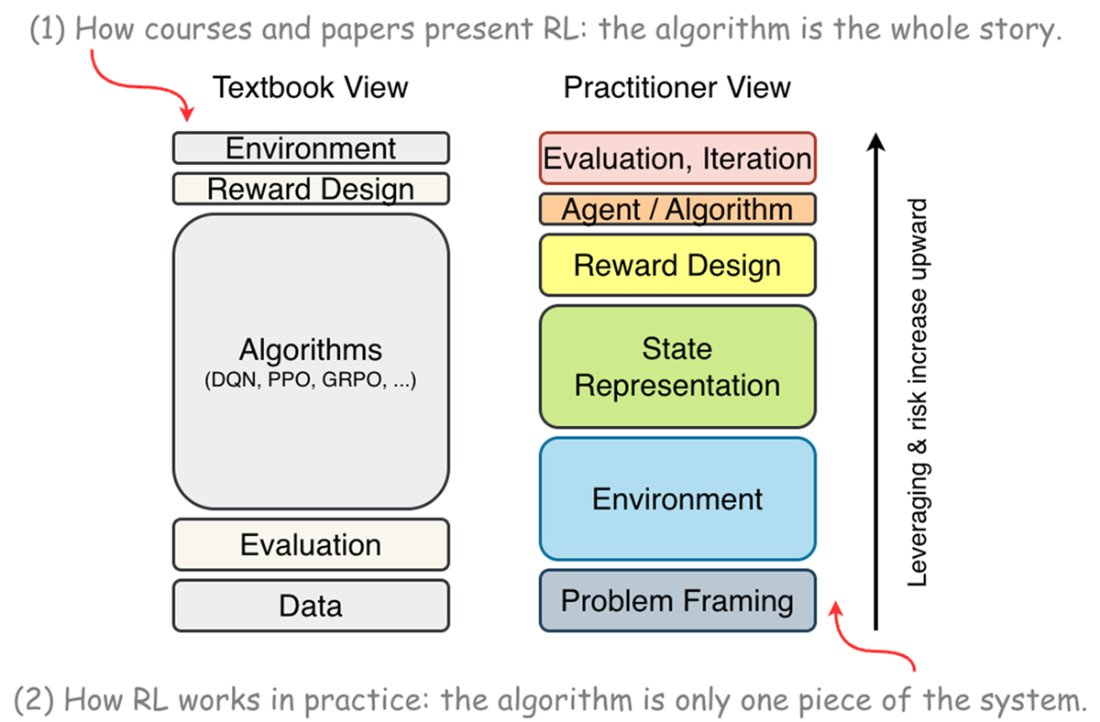
The diagram contrasts the textbook emphasis on algorithms with the practitioner’s emphasis on problem framing and the surrounding system layers. section 12.2