The decision lifecycle is a repeatable way to handle significant technical choices. It separates three activities that are easy to blur together: framing the decision, evaluating and choosing among options, and making the choice stick. It is an aid to judgment, not a promise that uncertainty will disappear or that every decision will pay off. section 1.3 section 1.5
Each phase addresses a different failure mode:
- Frame the decision: clarify the problem and its business and organizational context before assuming the solution is obvious. section 1.3 section 1.4
- Evaluate and choose: widen the option space before narrowing it to one choice, rather than settling immediately on a favored candidate. section 1.3
- Make the decision stick: carry the choice into execution and durable outcomes; an announcement alone is not completion. section 1.3
A frontend-library decision
A proposed library adoption gained business weight when it became part of a design and brand refresh. After several successful integrations, the organization committed to using the library for all new development. The sequence illustrates a move from establishing why the change mattered, through testing it, to making adoption durable. section 1.3
The phases need not run once in order. A failed prototype can prompt reframing; a new constraint can reopen evaluation. Spend more care and involve more stakeholders when a choice is hard to reverse. Move faster on reversible choices, while keeping trade-offs, timelines, and the people who must execute the decision in view. section 1.5 section 1.4
Figure 1.2 The decision lifecycle: framing and making the decision stick each move through mandatory steps, while evaluation widens the option space before narrowing it to a single choice
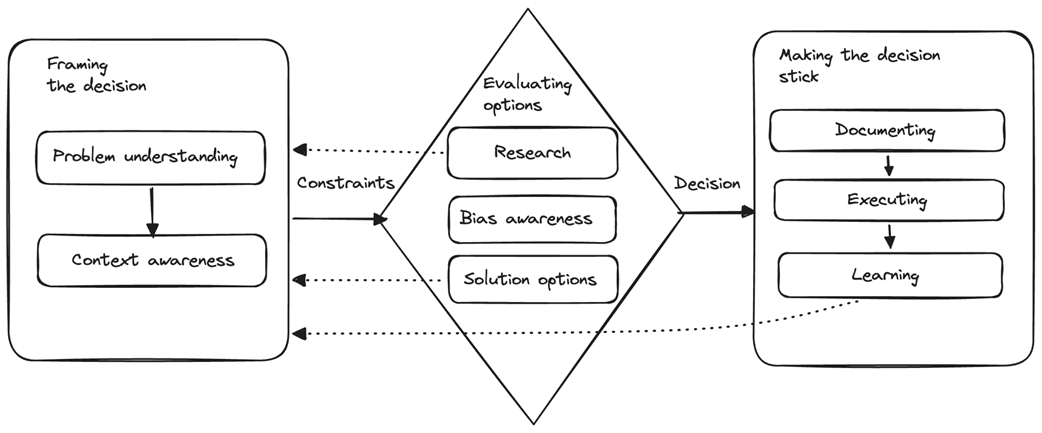
The diagram shows how evaluation widens the option space before narrowing it, between framing and making the decision stick. section 1.3