A technical decision is a choice among options made to serve a specific business outcome. A good decision considers the available options and known risks, rather than treating technical preference as sufficient. Its quality rests on the reasoning used at the time: uncertainty remains, and even a well-reasoned choice may not produce the hoped-for result. section 1.5
Match the effort spent deciding to the cost of being wrong:
- For a two-way-door choice that is relatively easy to reverse, try an option, observe the result, and adjust. A frontend component’s layout or a logging library in one microservice may warrant speed rather than extended debate. section 1.1.2
- For a one-way-door choice that is expensive or disruptive to reverse, use more careful analysis and involve stakeholders. Data storage architecture, a multi-year SaaS contract, or a company-wide architecture standard can affect an organization for years. section 1.1.2 section 1.5
Test before committing
Before adopting a library across an entire codebase, use it in a small isolated module. The trial can expose constraints while the choice is still easy to revisit. Broader adoption then calls for a decision at the appropriate scale, rather than treating a successful trial as the whole decision. section 1.1.2
Figure 1.1 Decisions that require structured analysis sit in the upper quadrants: high cost of change or high organisational impact.
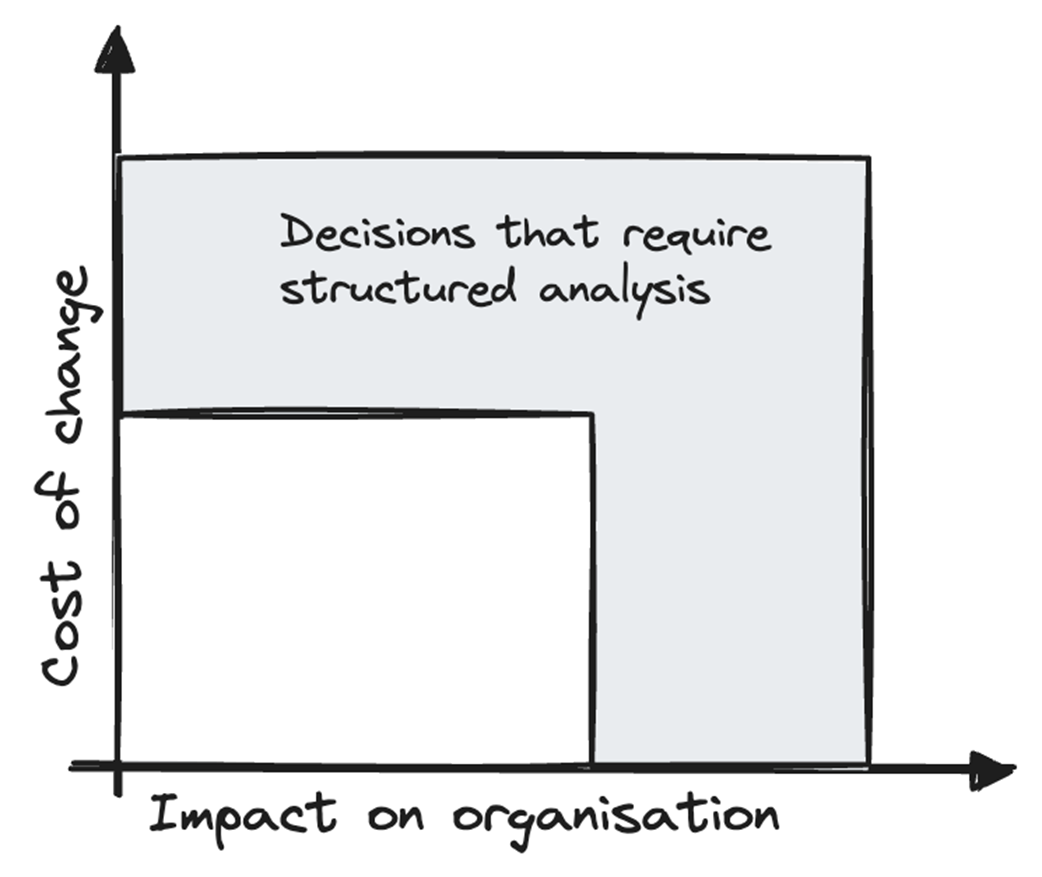
Use cost of change and organizational impact to judge when structured analysis is warranted; decisions high on either dimension sit in the figure’s upper quadrants. section 1.1.2
A repeatable decision lifecycle frames the choice, evaluates and selects options, then makes the choice stick in execution. It is not necessarily linear: a failed prototype or newly discovered constraint can prompt reframing, while difficulty putting a choice into practice can prompt renewed evaluation. section 1.5