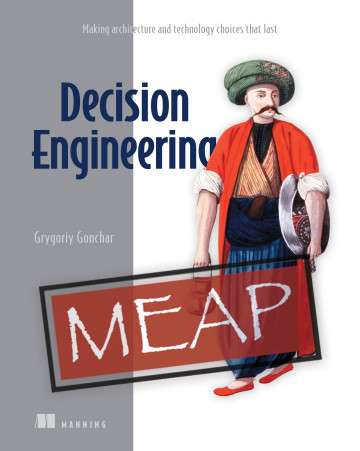
What you will learn in Decision Engineering
Making architecture and technology choices that last
Chapter by chapter
Chapter 1: Understanding technical decisions
The introduction explains why consequential technical choices require decision-making skill beyond software-building expertise, especially as AI speeds up coding.
What you learn in chapter 1 →Chapter 2: Understanding the problem
The chapter introduction explains why engineers must understand the problem and its business context before choosing a technical solution.
What you learn in chapter 2 →Chapter 3: Reading the context
This introduction explains why requirements alone do not determine the right technical choice and identifies the system, team, and company contexts that also shape it.
What you learn in chapter 3 →Chapter 4: Evaluating external technologies
The introduction explains why adopting external technology deserves a deliberate decision grounded in the organization’s needs and proportionate to the commitment.
What you learn in chapter 4 →Concepts explained in this book
- decision makingThe selection among technical alternatives in light of context, priorities, constraints, and uncertainty.
- company scaleCompany scale is an organization's size and stage of development as factors shaping its technical decisions.
- company archetypeA company archetype is a recurring organizational type, such as a startup, scale-up, or enterprise, with characteristic decision dynamics.
- architectural requirementAn architecturally significant requirement is a requirement whose correctness or fulfillment can determine or substantially change a system's architecture.
- evaluationThe decision activity of considering alternatives and converging on a choice.
- technical decisionA choice among technical options made to serve a specific business outcome while accounting for risks and uncertainty.
- community healthCommunity health is the condition of a technology project's contributor community, including its capacity to sustain participation and maintenance.
- nonfunctional requirementA requirement that specifies a system quality, constraint, or performance expectation rather than a function the system performs.
- security controlA measure intended to mitigate a security threat or satisfy a security or compliance requirement.
- guardrailA boundary or guideline that constrains choices while allowing teams to make decisions within it.
- decision lifecycleA model of decision-making as a set of recurring activities that move from clarifying a problem through evaluating options to carrying out a choice.
- technical strategyA long-term direction for an organization's technology choices that establishes operating boundaries and priorities.
- riskA risk is a potential adverse event or consequence that may affect a decision or its results.
- one-way doorA decision that is difficult to reverse and carries serious consequences.
- service tierA service tier is a named category representing a range of non-functional expectations with similar architectural implications.
- compliance requirementAn obligation that a system or organization must satisfy to meet applicable legal, regulatory, or other standards.
- voice of developer analysisAn analysis of developers’ feedback and public community experience with a technology.
- maintainabilityThe degree to which a software system can be understood, corrected, adapted, and enhanced over time.
- organizational contextCompany context is the organizational forces that shape which decisions are realistic at a particular stage of a company's life.
- jobs-to-be-doneJobs-to-Be-Done is a product-management framework that explains adoption in terms of customers hiring products to make progress in a circumstance.
- adoptionAdoption is the extent to which people or organizations take up and use a technology.
- prototypingThe creation and evaluation of preliminary versions of a product, system, or process.
- tradeoffA trade-off is a choice in which improving one consideration may require accepting a cost or limitation in another.
- prototypeA preliminary version of a product or system created to test ideas before fuller development.
- differentiating capabilityA differentiating capability is a business capability whose superiority to competitors creates customer value and competitive position.
- enabling capabilityAn enabling capability is a business capability needed to operate but whose superiority over competitors does not strongly differentiate the business.
- team contextThe experience, capabilities, and interpersonal dynamics of the people who will own a result.
- throughputThroughput is the amount of work or number of operations a system completes per unit of time.
- open-source signal mapAn open-source signal map is a model that positions projects by attention, indicated by stars, and actual usage, indicated by downloads.
- technological ecosystemA technology ecosystem is the community, tools, practices, and institutions surrounding a technology or programming language.
- upstream engagementUpstream engagement is working with the maintainers of a dependency project by reporting issues, improving documentation, or contributing changes.
- pricingThe terms and amounts at which a product or service is offered for purchase or use.
- governance modelThe structure that determines who has decision-making rights over a project and whose interests guide its direction.
- durabilityThe ability of a system to preserve data or completed operations despite failures or interruptions.
- complianceAdherence to applicable laws, regulations, standards, or other obligations.
- trial accessTrial access is temporary access to a product that allows prospective users to evaluate its behavior and suitability.
- system loadThe amount and kind of work a system must handle, such as request rates, data volume, concurrent users, and operations.
- two-way doorA decision that can be reversed when circumstances change.
- decision qualityThe merit of a decision as judged by the reasoning and process behind it rather than solely by its eventual outcome.
- problem understandingProblem understanding is the work of clarifying the problem, its context, and relevant constraints before choosing a solution.
These guides are generated from the text of Manning books by Manning's knowledge graph and link to the sections they draw on. The full books are available on liveBook and at manning.com.