An engineering manager may have a launch date, a team, and a wish list—but no shared route from one to the other. Project management turns that wish list into coordinated work: plan the milestones, clarify responsibilities and dependencies, track progress, and adapt when circumstances change. The plan matters even when the team cannot follow it exactly. section 10.0 section 10.1.3
Keep the work moving through three practical responsibilities:
- Plan and align: work backward from the desired outcome, divide the work into tasks and milestones, set timelines and owners, and agree on communication channels at kickoff. section 10.1.3
- Execute and adjust: support implementation and testing, check progress, discuss technical issues, and manage risks, dependencies, and changing resource needs. section 10.3 section 14.2.6
- Reflect afterward: measure success, address maintenance and technical debt, recognize contributions, and hold a retrospective. section 10.3
When the plan changes
Suppose a tracker shows that little time remains but several tasks are unfinished. Rather than waiting for the deadline, check whether the team needs more resources or whether priorities and plans should change. A tracker makes that conversation possible while there is still time to act. section 14.2.6
Table 10.1 A sample template for a working-backward plan
|
Timeline
|
Tasks and description
|
Owners
|
Status
|
|---|---|---|---|
|
T-3 months
|
Perform technical spikes.
Create a technical-design document.
Signoff by senior engineer/architect.
|
Engineering team
|
|
|
T-2 months
|
Coding is implemented.
QA testing is initiated.
|
Engineering team
QA
|
|
|
T-1 month
|
When implementation finishes, end-to-end testing is performed.
Security testing is performed.
User acceptance testing (UAT) is complete.
Bug fixes are done.
Code freeze occurs.
Launch readiness is achieved.
|
Engineering team
Security engineer
|
|
|
T
|
Launch
Postlaunch production support
|
.
|
|
|
T+1 month
|
Project retrospective
Measurement against success metrics
|
.
|
The working-backward template shows how a launch goal becomes dated tasks, owners, and status checks, followed by production support and a retrospective. section 10.1.3
Figure 10.3 A sample project tracker for Project Accessible to track a list of project items along with the priority, status, and other critical items
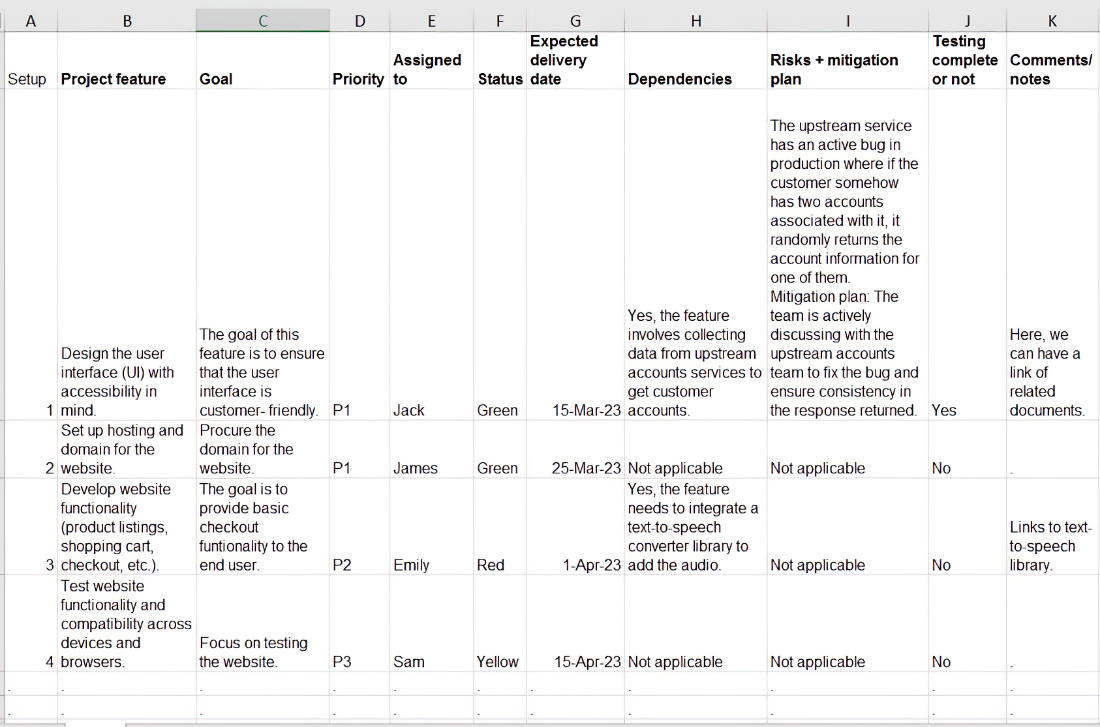
A sample project tracker shows the priority and status information used to make progress visible. section 10.1.3
Start with the outcome, then ask: What must happen before it, who owns each part, and how will the team notice trouble early? Revisit those answers as the project progresses. section 10.1.3 section 14.2.6



