Public-key infrastructure (PKI) secures Kubernetes client–server communication through certificates and a trusted certificate authority (CA). The CA signs certificates so clients can verify servers, while servers can require client certificates for mutual authentication. section 1.7
Kubernetes acts as its cluster CA and source of trust. kubectl, the kubelet, scheduler, controller manager, API server, and etcd use client or server certificates to authenticate requests and component connections. section 1.7 section 2.2.1
For practical inspection and exam preparation:
- List control-plane configuration with ls /etc/kubernetes; inspect kubelet.conf to find its API endpoint and client certificate path. section 2.2.1
- Review /etc/kubernetes/pki for the CA, API server, etcd-client, and kubelet-client certificates and keys. section 2.2.1
- Remember that one service can hold both certificates: the kubelet uses a client certificate for API authentication and a server certificate for proving its identity. section 2.2.1
Figure 2.14 Client and server certificate placement in Kubernetes
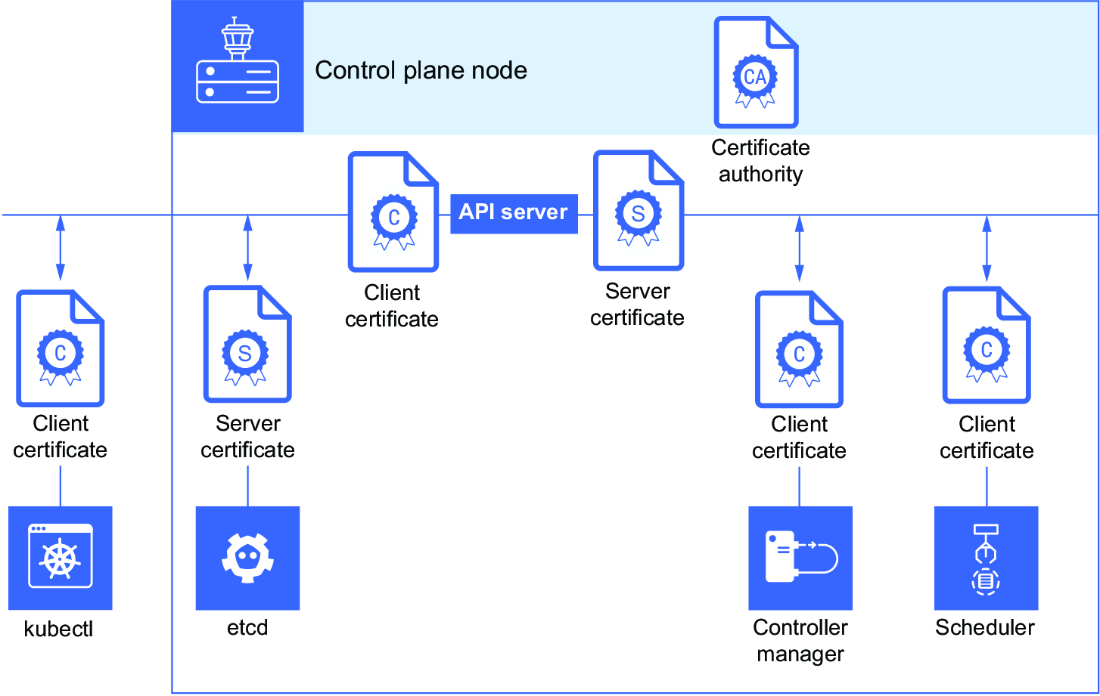
Use the certificate-placement diagram to map Kubernetes components to their client and server certificates. section 2.2.1

