A public-key infrastructure (PKI) turns one trusted authority into a scalable way to authenticate many public keys. The authority signs statements such as “Charles’s public key is 3848…,” allowing others to verify the mapping without already knowing Charles. section 7.1.3
Web PKI follows a simple trust chain:
- A browser arrives with verifying keys built into the program and trusts multiple authorities. section 7.1.3
- A website proves control of its domain to an authority, which signs the website’s public key. section 7.1.3
- During a secure visit, the browser verifies the authority’s signature, helping reject a public key supplied by a man-in-the-middle attacker. section 7.1.3
Beyond websites
S/MIME uses PKI rather than a web-of-trust model to authenticate identities and public keys in organizational email, especially where employee onboarding and offboarding are managed centrally. section 10.3.3
Figure 7.3 In the web PKI, browsers trust an authority to certify that some domains are linked to some public keys. When visiting a website securely, your browser can verify that the website’s public key is indeed theirs (and not from some MITM) by verifying a signature from the authority.
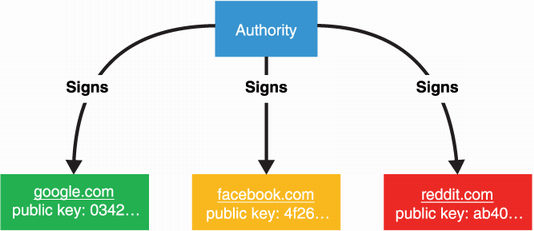
Trace how a browser trusts an authority’s signature to connect a domain name with the correct public key. section 7.1.3

